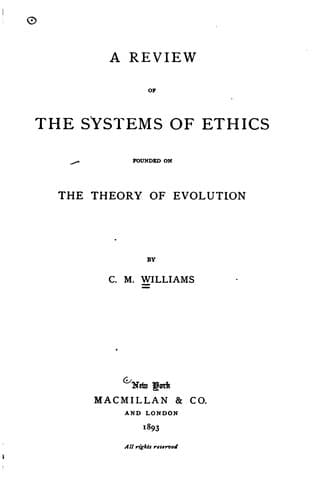
A Review of the Systems of Ethics Founded on the Theory of Evolution — John Shaqi
A Review of the Systems of Ethics Founded on the Theory of EvolutionWilliams, Cora May
Philosophy
A Review of the Systems of Ethics Founded on the Theory of Evolution
Williams, Cora May
Ethics, Evolutionary
The question as to the extent to which Reason is diffused in the
universe--Darwin and Haeckel on Reason and Instinct--Du Prel on
Reason as a fundamental property of all matter--Carneri on the
automatism of animals--The dependence of theories on this
question on the starting-point assumed in the
argument--Difficulties of assigning a limit-line to
Reason--Schneider's criteria--Insectivorous plants--Knight,
Darwin, etc., on the movements of plants--Race-habits--So-called
reflex-action in man--From non-analogy no inference
possible--Arbitrary nature of the assumptions involved in the
two starting-points of query--Reason = Cause or Effect?--Further
criticism of the concepts of Cause and Effect--The bias of the
specialist--Attempted definition of the province of
reason--Definition of "End"--Unreliability of inference as to
the nature of ends in other individuals; in other
species--Possible inferences from the analogy of the nervous
system--Certain possible limiting assumptions as to the province
of knowledge in animal species--The Law of the Variation of
Pain and Pleasure in function--The ultimate
dilemma--Examinations of Teleological conceptions with respect
to the Tendency to Stability--Criticism of Wallace on the Origin
of Life, or of Consciousness--Summary of conclusions 307-340
CHAPTER III
THE WILL
Difficulties of definition--The Will and
Consciousness--"Involuntary" action--Will in passivity--The
concept of Choice--"Ends" and the Will--The Future and Will--The
External and Will--Criticism of Barratt's axioms and
propositions--Discussion of the relation of Thought and Feeling
to Will--The argument of the Physiologist--The argument of the
Evolutionist--The argument from social statistics--The argument
from Psychiatry, Criminology, etc.--The argument from the
psychological principles on which Evolutional Ethics is
founded--Definition of Natural Law and Necessity--The positive
factors of Evolution--The positive and active character of the
organism as the result of evolution--The equivalence of
Conditions and Results--The positive character of the organism
as a part of Nature--The sense of Freedom as the sense of
Activity--The theory of the Will as determined by Motives--As
determined by Feeling--As determined by the desirability of the
end or object--The argument of Concomitance and that of Sequence
as used by both Materialist and Spiritualist--The endeavor to
prove (1) the causal character of physiological process; (2) the
causal character of Consciousness--Inconsistencies of these
attempts 341-359
CHAPTER IV
THE MUTUAL RELATIONS OF THOUGHT, FEELING, AND WILL IN EVOLUTION
Public-domain text, read in full here on John Shaqi.
Reviews
Reviews
No reviews yet
Be the first to share your thoughts on this work.
Join the Discussion
Join the discussion
Sign in to leave a comment or review.
Sign InorCreate an account