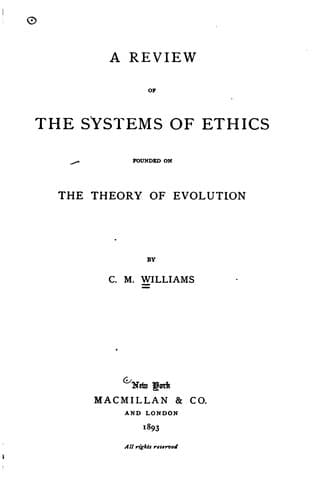
A Review of the Systems of Ethics Founded on the Theory of EvolutionWilliams, Cora May
Philosophy
A Review of the Systems of Ethics Founded on the Theory of Evolution
Williams, Cora May
Ethics, Evolutionary
In his "Anthropogenie" (1874), Haeckel says: "The soul, or 'psyche' of
man has evolved, as function of the cerebro-spinal nerve-chord
simultaneously with the latter, and just as, even yet, brain and spinal
column develop from the simple nerve-chord, so the human mind, or the
soul-activity of the whole human race, has evolved, gradually and step
by step, from the lower vertebrate soul. 'Spirit' and 'soul' are only
higher and combined or differentiated powers of the same function which
we designate with the general expression 'force.'"[34] In his essay on
"Cell-souls and Soul-cells" (1878), Haeckel attributes to all animals
the possession of soul, and adds that "we cannot wholly deny a soul to
the plants also." The possession of soul he defines as the "capacity of
sensibility in the organism to excitations of various sorts, and of
reaction upon these excitations with certain movements." "This uniform
character of protoplasm gifted with soul permits us the hypothesis that
the ultimate factors of the soul-life are the plastidules, the
invisible, homogeneous, elemental particles, or molecules, of
protoplasm, which, in limitless multiplicity, compose the unnumbered
cells." The soul connected with the higher developments of brain and
spinal column is likewise a higher development, and differs from the
soul connected with the uncentralized organization of lower species. In
the latest edition of his "Natuerliche Schoepfungsgeschichte" (1889), he
further asserts that all matter is possessed of soul, and that "the
antithesis which we have assumed between living and dead nature does not
exist. When a stone, thrown into the air, falls to the earth according
to fixed laws, or when a crystal is formed in a solution of salts, or
when sulphur and quicksilver combine to form cinnabar, these phenomena
are not more and not less mechanical phenomena of life than the growth
and bloom of the plants, than the propagation and sense-activity of
animals, than the perception and thought-processes of human beings."[35]
And both in this work and in his "Anthropogenie" he quotes the words of
Goethe, that "matter can never exist and act without soul, the soul can
never exist and act without matter." This last statement is, however,
rather a metaphysical one, in distinction from Haeckel's other
statements on this subject, which are properly naturalistic.
Public-domain text, read in full here on John Shaqi.
Reviews
Reviews
No reviews yet
Be the first to share your thoughts on this work.
Join the Discussion
Join the discussion
Sign in to leave a comment or review.
Sign InorCreate an account