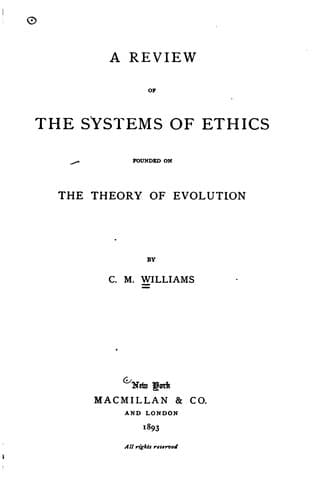
A Review of the Systems of Ethics Founded on the Theory of EvolutionWilliams, Cora May
Philosophy
A Review of the Systems of Ethics Founded on the Theory of Evolution
Williams, Cora May
Ethics, Evolutionary
In his lecture on "Cell-souls and Soul-cells," Haeckel says of instinct:
"Unbiassed observation, applying its tests without prejudice, shows
conclusively that the so-called 'instinct' of the animals is nothing
else than a sum of psychical functions originally acquired by
adaptation, fixed by habit, and descending from generation to
generation by inheritance. Originally carried out with consciousness and
reflection, many instinctive actions of the animals have become
unconscious, as have, in like manner, the ordinary acts of intelligence
in man. These too, may, with the same justice, be regarded as the
expression of innate instinct, as often is the impulse to
self-preservation, maternal love, and the social impulse. Instinct is
not an exclusive attribute of the animal-brain, nor is reason an
especial endowment of man; there is, on the contrary, for the unbiassed
observer, a long, long scale of gradual improvement and evolution in
psychic life, which may be traced step by step, from the higher to lower
human beings, from the perfect to the imperfect animals, until we reach
those simple worms, whose nerve-ganglia are the beginning of all the
numberless brain-forms of the scale."
In his "Anthropogenie," Haeckel denies Free Will, maintaining that all
phenomena are the result of mechanical causes--_causae efficientes_, not
_causae finales_. In an essay on the "Relation of the Theory of Evolution
in its present form to Science in General" (1877), he says of Ethics:
"By far the most important and the most difficult demand which Practical
Philosophy makes upon the theory of Evolution seems to be that of a new
theory of Morals. Certainly in the future, as in the past, the careful
development of moral character and of religious conviction must be the
chief problem of education. But until now the greater number of people
have clung to the conviction that this most important problem could be
solved only in connection with certain ecclesiastical articles of faith.
And since these dogmas, especially as connected with ancient myths of
the Creation, are in direct opposition to the facts of evolution, the
latter have been believed to be, in the highest degree, inimical to
religion and morality.
Public-domain text, read in full here on John Shaqi.
Reviews
Reviews
No reviews yet
Be the first to share your thoughts on this work.
Join the Discussion
Join the discussion
Sign in to leave a comment or review.
Sign InorCreate an account