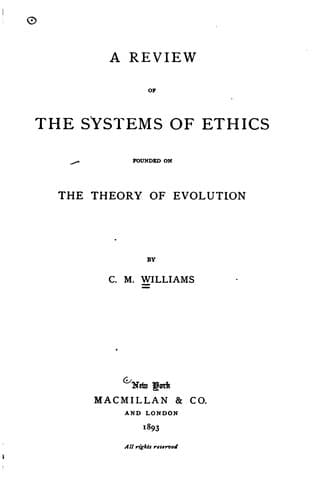
A Review of the Systems of Ethics Founded on the Theory of EvolutionWilliams, Cora May
Philosophy
A Review of the Systems of Ethics Founded on the Theory of Evolution
Williams, Cora May
Ethics, Evolutionary
It has been said that codes derived from the moral sense have no
stability since this sense ratifies one principle at one time and place,
another at another. The same objection applies, however, to every other
system of morals, and happily there is an answer to the objection. The
error criticised is one of application, not of doctrine. The decisions
of the Geometric Sense are conflicting; yet there are certain axioms
upon which all agree; and in the same manner there are moral axioms to
be found, upon which all must agree. Disagreement is to be looked for
among imperfect characters. But nature's laws know no exception: Obey or
suffer are the alternatives. A progress from entire unconsciousness of
these laws to the conviction that law is universal and inevitable,
constancy an essential attribute of divine rule, is the substance of the
progress of man. The end of these unbending utterances is universal
good; we have no alternative but to assume the law of constancy to be
the best possible one. As with the physical, so with the ethical; all
religions teach the inevitableness of punishment and reward, with which
deeds are _necessarily_ and _indissolubly_ connected. It is of infinite
importance to recognize and follow the laws of society. To the objection
that one cannot always be guided by abstract principles, that there are
exceptions where prudence must act, it may be replied that there are no
exceptions to the laws of nature; that even if, in a particular
instance, partial good may result, a far greater general evil is
entailed by the opening of the way to future disobediences, and that we
cannot, moreover, be sure that an exceptional disobedience will bring
the anticipated benefits. Moral as well as physical evil is the result
of a want of congruity between the faculties and their sphere of action.
With regard to the results of varying conditions upon man, we have three
alternative theories from which to choose: either man remains entirely
unaltered by his surroundings, or he grows more unfitted for them, or
else he grows more fitted for them. The first two suppositions being
absurd, we are obliged to admit the remaining one. And since all evil
results from non-adaptation, and non-adaptation is being continually
diminished, it follows that evil must be continually diminishing. The
evil in society shows that man is not yet completely adapted to a state
which requires that each individual shall have such desires only as may
be fully satisfied without trenching upon the ability of other
individuals to obtain a like satisfaction. The primitive condition of
man required that he should sacrifice the welfare of other beings to his
own; the old attribute still clings to him in some measure; the belief
in human perfectibility amounts to the belief that man will eventually
become completely suited to his mode of life. Progress is not an
accident but a necessity; and if, instead of proposing it as a rule of
Public-domain text, read in full here on John Shaqi.
Reviews
Reviews
No reviews yet
Be the first to share your thoughts on this work.
Join the Discussion
Join the discussion
Sign in to leave a comment or review.
Sign InorCreate an account