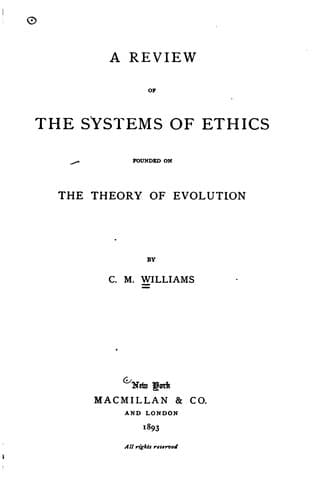
A Review of the Systems of Ethics Founded on the Theory of EvolutionWilliams, Cora May
Philosophy
A Review of the Systems of Ethics Founded on the Theory of Evolution
Williams, Cora May
Ethics, Evolutionary
human conduct, Bentham had simply assumed the "greatest happiness" to be
the creative purpose, his position would have been tenable enough. It is
one thing, however, to hold that greatest happiness is the creative
purpose, and quite a different thing to hold that greatest happiness
should be the immediate aim of mankind. Truth has two sides, a divine
and a human; or, it is for man to ascertain the conditions which lead to
the greatest happiness, and to live in conformity with these.
The men who are to realize this greatest sum of happiness must be such
as can obtain complete happiness without diminishing the activity and
happiness of others. The first great condition of the attainment of the
end is, therefore, justice, and, as a supplement to this, negative and
positive beneficence,--abstinence from diminishing the spheres of
activity of others, and further, a positive increase of their pleasure.
For man is sympathetic, and the sympathetic pleasures increase the sum
total of happiness.
The exercise[38] of all the faculties in which happiness consists is not
only man's right but also his duty. For the fact of pain, of punishment,
proves that God intends and wills such exercise. But the exercise of all
the faculties is freedom; all men have, therefore, a right to freedom of
action. This principle, however, implies a limitation of man by men,
whereby we arrive at the general proposition that every man may claim
the fullest liberty to exercise his feelings _compatible with the
possession of a like liberty in every other man_. In the progress of
mankind, or adaptation, the conduct which hurts necessary feelings in
others must inevitably undergo restraint and consequent limitation;
conduct which hurts only their incidental feelings, as those of caste or
prejudice, will not inevitably be restrained, but if it springs from
necessary feelings, will, on the contrary, be continued at the expense
of these incidental feelings and to their final suppression. Morality is
_not_, therefore, to be interpreted as a refraining from the infliction
of any pain whatever, for some sentiment must be wounded; and by much
wounding it is gradually weakened. When men mutually behave in a way
that offends some essential element in the nature of each, and all in
turn have to bear the consequent suffering, there will arise a tendency
to curb the desire that makes them so behave.
Questions of individual morality seem to present a difficulty to this
theory of freedom. Thus, for instance, on the principle above adopted,
the liberty of drunkenness cannot be condemned as long as the drunkard
respects a like liberty in others; and here we fall into the
inconsistency of affirming that a man is at liberty to do something
essentially destructive of happiness. However, if we admit, as we must,
that liberty is the _primary_ law, no desire to get a secondary law
fulfilled can warrant us in breaking this primary one; we must deal with
secondary laws as best we can.
Public-domain text, read in full here on John Shaqi.
Reviews
Reviews
No reviews yet
Be the first to share your thoughts on this work.
Join the Discussion
Join the discussion
Sign in to leave a comment or review.
Sign InorCreate an account