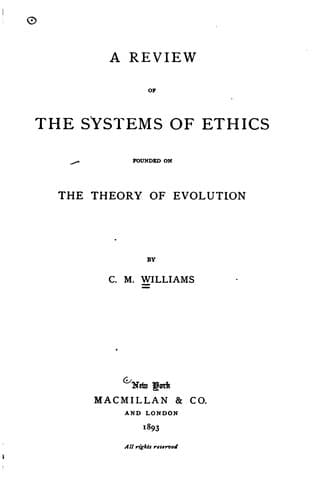
A Review of the Systems of Ethics Founded on the Theory of EvolutionWilliams, Cora May
Philosophy
A Review of the Systems of Ethics Founded on the Theory of Evolution
Williams, Cora May
Ethics, Evolutionary
The first principle above stated may also be secondarily derived. The
regulation of conduct is not left to the accident of a philosophical
inquiry; the agent of morality is the Moral Sense.
In all ages, but more especially in recent ones, have there been
affirmations of the equality of all men and their equal right to
happiness. When we find that a belief like this is not only permanent
but daily gaining ground, we have good reason to conclude that it
corresponds to some essential element of our moral constitution; more
especially since we find that its existence is in harmony with that
chief prerequisite to greatest happiness lately dwelt upon; and that its
growth is in harmony with the law of adaptation, by which the greatest
happiness is being wrought out.
To assert, however, that the sense of justice is but the gradually
acquired conviction that benefits spring from some kinds of action, and
evils from other kinds, the sympathies and antipathies contracted
manifesting themselves as a love of justice and a hatred of injustice,
is as absurd as to conclude that hunger springs from a conviction of the
benefit of eating.
The Moral Sense must be regarded as a special faculty, since, otherwise,
there would be nothing during the dormancy of the other faculties, which
must sometimes occur, to prevent an infringement on the freedom
requisite for their future action.
As Adam Smith has shown in his "Theory of Moral Sentiments," the proper
regulation of our conduct to others is secured by means of a faculty
whose function it is to excite in each being the emotions displayed by
the beings about him. The sentiment of justice is nothing but a
sympathetic affection of the instinct of personal rights, a sort of
reflex function of it. Other things being equal, those persons
possessing the strongest sense of personal rights have, also, the
strongest sense of the rights of others. There is no _necessary_
connection between the two; but in the average of cases they bear a
constant ratio.
It may be objected that if the truth that every man has a freedom to do
all that he wills, provided he infringe not upon the equal freedom of
others, be an axiom, it should be recognized by all, as is not the case.
This difficulty seems in part due to the impossibility of making the
perfect law recognize an imperfect state. It may further be answered
that the Bushman knows nothing of the science of mathematics, yet that
arithmetic is a fact; the difference in men's moral perceptions is no
difficulty in our way, but rather illustrates the truth of our theory,
since man is not yet adapted to the social state.
Public-domain text, read in full here on John Shaqi.
Reviews
Reviews
No reviews yet
Be the first to share your thoughts on this work.
Join the Discussion
Join the discussion
Sign in to leave a comment or review.
Sign InorCreate an account