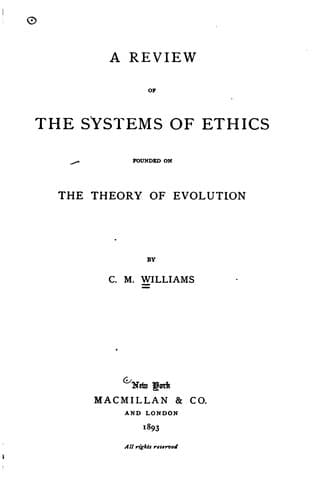
A Review of the Systems of Ethics Founded on the Theory of EvolutionWilliams, Cora May
Philosophy
A Review of the Systems of Ethics Founded on the Theory of Evolution
Williams, Cora May
Ethics, Evolutionary
insuperable difficulty in the notion that at some period in the
evolution of humanity this divine spark [the soul] may have acquired
sufficient concentration and steadiness to survive the wreck of material
forms and endure forever. Such a crowning wonder seems to me no more
than the fit climax to a creative work that has been ineffably beautiful
and marvellous in all its myriad stages."
Fiske gives some further definition of social evolution in man, in his
"Cosmic Philosophy" (1874). He there denies the incompatibility of
free-will with causation, saying that "it is the doctrine of
lawlessness, and not the causationist doctrine, which is incompatible
with liberty and destructive of responsibility."[54]
He further postulates heterogeneity of the environment as "the chief
proximate determining cause of social progress," and defines such
evolution as "a continuous establishment of psychical relations within
the community, in conformity to physical and psychical relations arising
in the environment, during which both the community and the environment
pass from a state of relatively indefinite, incoherent homogeneity to a
state of relatively definite, coherent heterogeneity; and during which
the constituent units of the community become ever more distinctly
individual."[55] "The progress of a community, as of an organism, is a
process of _adaptation_--the continuous establishment of inner relations
in conformity to outer relations. If we contemplate material
civilization under its widest aspect, we discover its legitimate aim to
be the attainment and maintenance of an equilibrium between the wants
of men and the outward means of satisfying them. And while approaching
this goal, society is ever acquiring in its economic structure both
greater heterogeneity and greater specialization. It is not only that
agriculture, manufactures, commerce, legislation, the acts of the ruler,
the judge, and the physician, have, since ancient times, grown
immeasurably multiform, both in their processes and in their appliances;
but it is also that this specialization has resulted in the greatly
increased ability of society to adapt itself to the emergencies by which
it is now beset."[56] Religion, too, is adjustment; form after form has
been outgrown and perished, yet the life of Christianity, incorporated
in ever higher forms, is continually renewed. The omission of the moral
feeling, as a factor, from Comte's interpretation of the progress of
society, is a fatal defect, since moral and social progress depend more
on feelings than on ideas. As Wallace shows, tribes which combined for
mutual help and protection, restrained appetite by foresight, and felt
sympathy, would have an advantage in the struggle for existence.
Public-domain text, read in full here on John Shaqi.
Reviews
Reviews
No reviews yet
Be the first to share your thoughts on this work.
Elsewhere in the archive
Join the Discussion
Join the discussion
Sign in to leave a comment or review.
Sign InorCreate an account