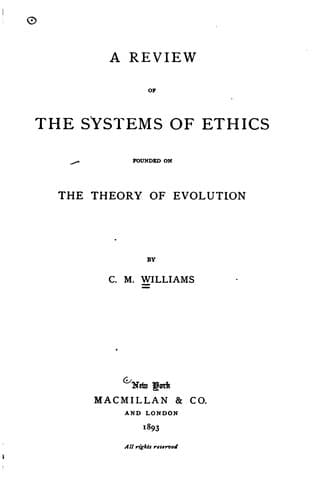
A Review of the Systems of Ethics Founded on the Theory of EvolutionWilliams, Cora May
Philosophy
A Review of the Systems of Ethics Founded on the Theory of Evolution
Williams, Cora May
Ethics, Evolutionary
"As surely as the astronomer can predict the future state of the
heavens, the sociologist can foresee that the process of adaptation must
go on until, in a remote future, it comes to an end in proximate
equilibrium. The increasing interdependence of human interests must
eventually go far to realize the dream of the philosophic poet, of a
Parliament of Man, a Federation of the World.
"'When the kindly earth shall slumber, lapt in universal law,' and when
the desires of each individual shall be in proximate equilibrium with
the means of satisfying them and with the simultaneous desires of all
surrounding individuals."[57]
FOOTNOTES:
[54] Vol. II. p. 189.
[55] Ibid. p. 223, 224.
[56] Vol. II. p. 212.
[57] Ibid. pp. 227, 228.
W. H. ROLPH
"BIOLOGICAL PROBLEMS" ("Biologische Probleme," 1884)
For what purpose are we in the world? asks the philosopher, and lays,
with this question, the foundation for later errors. In the effort to
rescue from destruction the theory of a creative intelligence, teleology
has adapted itself to many forms of scientific theory, not excepting
that of evolution. It reads into evolution progress towards what is, in
one way or another, assumed to be an end. But we really know, in the
universe, nothing but continuity, eternal change according to natural
law, and so only _causae efficientes_, never _causae finales_; and organic
development as well as processes in inorganic nature are to be explained
in this manner. The assumption that the result of a process is an end
towards which the process was directed is unwarranted. The question of
science is not: Wherefore is any creature in the world? but: What is he?
What is his actual aim, that is, his endeavor?
In the answer to this question, all philosophical schools have something
in common. Happiness, in one form or another, is acknowledged to be the
"end" of life in this sense. A follower of the utilitarian school may
define happiness as the "sublime feeling that one has taken part in the
continuous improvement of humanity, and the increase of human
happiness," but his words are less a definition of the concept than a
designation of the way in which happiness is to be arrived at. The
"sublime feeling" can be represented only as a feeling of happiness, of
joy. The religious theory, too, which represents the joys of religion on
earth and in heaven, as compensating for the evils of this life, makes
happiness the end of life, though in a different manner. Spencer is
right in declaring that happiness, however it may be defined, always
means, in the end, a greater amount of pleasure than of pain. At this
point, however, the harmony of the schools ceases. The question as to
the method by which this surplus of pleasure is to be obtained is
answered in different ways. All say, indeed, by seeking good and
avoiding evil. But opinion is divided as to what is good and what is
evil.
Public-domain text, read in full here on John Shaqi.
Reviews
Reviews
No reviews yet
Be the first to share your thoughts on this work.
Elsewhere in the archive
Join the Discussion
Join the discussion
Sign in to leave a comment or review.
Sign InorCreate an account