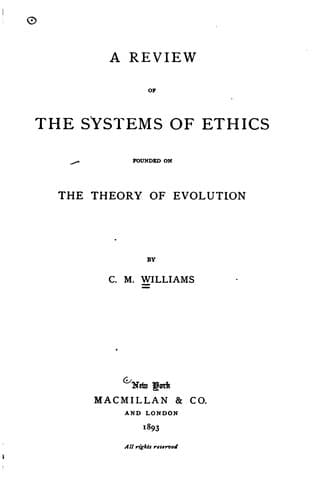
A Review of the Systems of Ethics Founded on the Theory of EvolutionWilliams, Cora May
Philosophy
A Review of the Systems of Ethics Founded on the Theory of Evolution
Williams, Cora May
Ethics, Evolutionary
We have abundant proof of this in the fact that domesticated
species, which are carefully tended and fed, and so wholly withdrawn
from the struggle for existence, vary enormously, and produce the most
wonderful monstrosities.
To what direct causes the appearance of a variety is due, is a question
as yet unanswered. But Weismann's investigations have shown us that
climate plays a large part in their development. Embryology teaches us,
moreover, that the development of the young organism does not take place
with the same uniformity in all organs, but that, on the contrary, in
one period one organ, in another, another, undergoes a more rapid
growth, which may be influenced by variations in food or temperature.
Through such variations the development of monstrosities is explained.
We know that influences of nourishment are operative in the development
of the larvae of bees to workers or to queens, and we can easily conceive
that other organs besides the sexual are subject to these influences.
The field in which such influences may be operative is, indeed,
boundless.
All these considerations lead us to the conclusion that variability in
general, but especially that variability resulting in a so-called
improvement of the varieties producing it, is an accompaniment of
prosperous conditions. This is a conclusion not yet reached in zooelogy,
although botanists long ago recognized, in abundance of food, the most
essential condition for the development of variations.
Darwinism fails to account for any need of nourishment beyond that
necessary for the maintenance of the _status quo_ of life. According to
Darwin, the animal can acquire only sufficient for the repair of loss.
The struggle for existence is, therefore, according to him, a struggle
of self-defence, and its results could be, at the best, only the
maintenance of species in their present position or, in a less favorable
case, their decline, and finally their destruction. But this view is
wholly false. The animal acquires not only enough to repair loss, but
much more. How could the first amoeba have propagated itself, if it
consumed no more than it needed for mere self-maintenance, and how could
evolution have taken place? We have seen that, even in the inorganic
world, there is not an equality of loss and repair, but that, in osmose,
the denser fluid takes up more than it gives, while the fluid that is
less dense loses more than it receives, and the mutual exchange reaches
the maximum possible under the existing circumstances. It is this
characteristic which renders the involuntary and forced tendency of the
organism to satiation independent of the amount of waste; this
mechanical hunger is the spring of the insatiability of organisms, and
explains to us their increase in number, the process of increasing
perfection, and individual development. Without it, an eternity would
not have sufficed for evolution; we should still have only a world of
primitive amoebae.
Public-domain text, read in full here on John Shaqi.
Reviews
Reviews
No reviews yet
Be the first to share your thoughts on this work.
Elsewhere in the archive
Join the Discussion
Join the discussion
Sign in to leave a comment or review.
Sign InorCreate an account