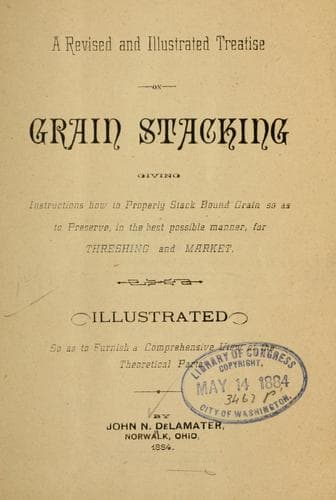
A revised and illustrated treatise on grain stackingDe Lamater, John N.
Science
A revised and illustrated treatise on grain stacking
De Lamater, John N.
Grain
Produced by Matthew Wheaton and The Online Distributed
Proofreading Team at https://www.pgdp.net (This file was
produced from images generously made available by The
Internet Archive)
A Revised And Illustrated Treatise On Grain Stacking
GIVING
_Instructions how to Properly Stack Bound Grain so as
to Preserve, in the best possible manner, for
THRESHING and MARKET._
ILLUSTRATED
_So as to Furnish a Comprehensive View of the Theoretical Parts_
BY
JOHN N. DeLAMATER,
NORWALK, OHIO
1884.
Copyright 1884 by
JOHN N. DeLAMATER,
All Rights Reserved.
THE NORWALK CHRONICLE PRINT.
PREFACE.
So far as I am aware, this is an untried field of labor--a work which I
have had under consideration for the last fifteen years; during which
time the closest attention has been given to details of building, and
careful observations made on results, when the stacks were being taken
down.
JOHN N. DeLAMATER.
TREATISE ON GRAIN STACKING.
PLACING FOUNDATION.
If convenient, make a foundation of rails, by placing three rails about
four and one-half feet apart and parallel, and then add half or two
thirds the length of a rail to each, and cover by laying rails
crossways, and finish by laying a large rail or post in the center
lengthways.
This will form a foundation large enough for ten or twelve large loads.
If rails, poles or boards cannot be had for an entire foundation,
endeavor to get something to support the heads of a few center sheaves;
for if sheaves are set on end to commence a stack, the middle is apt to
settle too much.
COMMENCING TO BUILD.
On the rail foundation, lay around the center in the form of an ellipse,
with the heads lapping well across the center rail; lap half and
continue to lay towards the outside until foundation is covered. Now
commence at the outside and lay a course around, neither laying out or
drawing in, except to correct any little error that may occur in the
elliptical form of the stack; complete the courses to the center, but
don't fill the middle too full; if the outside is lower than the middle,
lay a double course around outside; keep your stack _flat_--full as high
at outside as center; build the first load straight up, neither laying
out or drawing in, if the stack is to contain ten or twelve loads; if
eight or nine, lay the last course out a little.
LAYING OUT.
Public-domain text, read in full here on John Shaqi.
Reviews
Reviews
No reviews yet
Be the first to share your thoughts on this work.
Join the Discussion
Join the discussion
Sign in to leave a comment or review.
Sign InorCreate an account