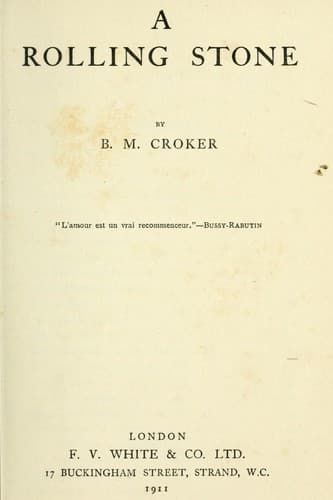
England -- Social life and customs -- 20th century -- Fiction; Household employees -- Fiction; Young men -- Fiction
The plausible, insidious scoundrel, who lived by his wits, was on his
last legs--though he kept the fact a secret--was seen everywhere,
carried a bold front, and owned a magnificent 60 h.p. motor, which
was useful in more ways than one. He was staying at the Métropôle at
Folkestone, and, struck by a bright idea--so he declared--motored over
to Canterbury one fine Sunday morning, and carried off his friend to
lunch.
As they sat smoking and discussing recent race meetings, weights, and
jockeys, de Montfort suddenly put down his cigar and said--
“I say, look here, Owen, old man. I’m in rather a tight fix this week.
I want two thousand to square a bookie--and, like the real sporting
chap you are--will you back my name on a bill?”
Owen’s expression became unusually grave; backing a bill was an
iniquity hitherto unknown to him. Uncle Dick had recently paid up
handsomely, and he had given certain promises; and, indeed, had
curtailed his expenses, sold two of his ponies, and had made up his
mind to keep strictly within his allowance.
“Of course it’s a mere form,” pursued de Montfort, in his swaggering,
off-hand way, “I swear to you. Do you think I’d ask you, if it was not
safe as a church! I’ll have the coin in a fortnight; but just at the
moment I’m terribly short, and you know yourself what racing debts
mean. So I come to you, my old pal, before any one; you are such a
rare, good, generous, open-handed sort! Don’t for a moment suppose that
_you_ will be responsible,” declared this liar; “I’ll take up the bill
when it falls due; I’d as soon let in my own mother as a pal like you.”
In short, Hugo was so urgent and so plausible, that his victim was
persuaded and carried away by eloquence and old memories, accompanied
de Montfort to a writing-table, where he signed O. St. J. Wynyard--and
repented himself before his signature had been blotted!
Two days later Owen received a beautiful silver cigarette-case,
inscribed, as a token of friendship from de Montfort, and this was
succeeded by an alarming silence. When the time approached for
the bill to fall due, Wynyard wrote anxious epistles to his old
schoolfellow--who appeared to be one of the crowd who believe that
letters answer themselves! Then he went up to town and sought him at
his rooms and club; no one could give him any tidings of Hugo beyond
the fact that he was abroad--a wide and unsatisfactory address. He sent
distracted telegrams to some of the runaway’s former haunts; there was
no reply. The fatal day arrived, and Owen was compelled to interview
his uncle and make a clean breast of the whole business; and his uncle
was furious to the verge of apoplexy.
“They used to say,” he shouted, “put the fool of the family into the
army; but _my_ fool shall not remain in the Service! I’ll pay up the
two thousand you’ve been robbed of for the sake of my name--and out
you go! Send in your papers to-day!”
* * * * *
Public-domain text, read in full here on John Shaqi.
Reviews
Reviews
No reviews yet
Be the first to share your thoughts on this work.
Join the Discussion
Join the discussion
Sign in to leave a comment or review.
Sign InorCreate an account