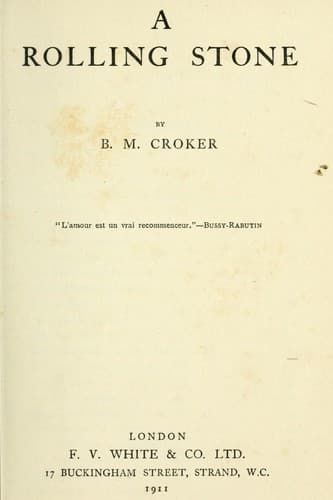
England -- Social life and customs -- 20th century -- Fiction; Household employees -- Fiction; Young men -- Fiction
Lady Kesters was contemplating her face in the overmantle, which also
reflected her brother’s unusually grave visage.
“Owen,” she said, “what a pity it is that I hadn’t your looks and you
my brains.”
They presented a contrast, as they examined one another in the glass.
The woman’s dark, irregular face, her keen, concentrated expression;
the man with clear-cut features, sleepy, deep-set grey eyes, and
close-cropped light brown hair.
“I think you are all right as you are, Sis,” he remarked, after a
reflective pause.
“But you are not,” she snapped. “Now, if you had my head. Oh, how I
long to be a man! I’d have gone into Parliament. I’d have helped to
manage the affairs of a nation instead of the affairs of a family. I’d
have worked and slaved and made myself a name--yes, and gone far!”
“What’s the good of going far?” he asked, in a lazy voice.
“Ah,” she exclaimed, with a touch of passion, “you have no ambition;
you don’t even know what the word means! Look at the men in the
Commons, who have worked themselves up from nothing to be powers in
the land, whose influence is far-reaching, whose voices are heard at
the ends of the earth. What would be your ambition, come now?” and she
surveyed him with sparkling eyes.
“Certainly not to go into Parliament,” he answered, “and sit in the
worst atmosphere in London for eight months of the year.”
“Well, at least it’s an electrical atmosphere, charged with vitality!
And your ambition?” she persisted.
“To win the Grand National, riding my own horse, since you must know.”
“Pooh!” she exclaimed, snapping her fingers with a gesture of scorn,
“and what a paltry aim!--the yells of a raving mob, a ‘para’ in the
papers, and the chance of breaking your neck.”
“Better than breaking something else! I’m told that a political career,
with its incessant work, crushing disappointments, worry, and fag, has
broken many a fellow’s heart.”
“Heart! Nonsense; I don’t believe you have one. Well, now, as we are
dining early, you had better see about your things from Ryder Street,
and I will go and ’phone for stalls for _The Giddy Girl_.”
CHAPTER III
THE LAST WORD GOES BEGGING
Public-domain text, read in full here on John Shaqi.
Reviews
Reviews
No reviews yet
Be the first to share your thoughts on this work.
Join the Discussion
Join the discussion
Sign in to leave a comment or review.
Sign InorCreate an account