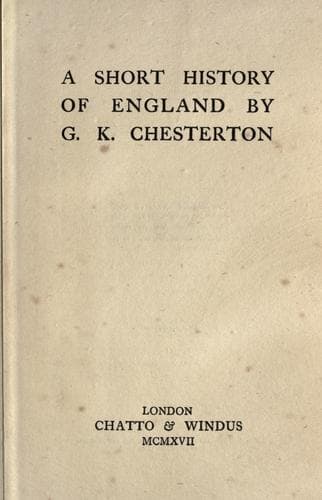
A Short History of EnglandChesterton, G. K. (Gilbert Keith)
History
A Short History of England
Chesterton, G. K. (Gilbert Keith)
Great Britain -- History
extended the franchise to the artisans, partly, indeed, as a party move
against his great rival, Gladstone, but more as the method by which the
old popular pressure was first tired out and then toned down. The
politicians said the working-class was now strong enough to be allowed
votes. It would be truer to say it was now weak enough to be allowed
votes. So in more recent times Payment of Members, which would once have
been regarded (and resisted) as an inrush of popular forces, was passed
quietly and without resistance, and regarded merely as an extension of
parliamentary privileges. The truth is that the old parliamentary
oligarchy abandoned their first line of trenches because they had by
that time constructed a second line of defence. It consisted in the
concentration of colossal political funds in the private and
irresponsible power of the politicians, collected by the sale of
peerages and more important things, and expended on the jerrymandering
of the enormously expensive elections. In the presence of this inner
obstacle a vote became about as valuable as a railway ticket when there
is a permanent block on the line. The facade and outward form of this
new secret government is the merely mechanical application of what is
called the Party System. The Party System does not consist, as some
suppose, of two parties, but of one. If there were two real parties,
there could be no system.
But if this was the evolution of parliamentary reform, as represented by
the first Reform Bill, we can see the other side of it in the social
reform attacked immediately after the first Reform Bill. It is a truth
that should be a tower and a landmark, that one of the first things done
by the Reform Parliament was to establish those harsh and dehumanised
workhouses which both honest Radicals and honest Tories branded with the
black title of the New Bastille. This bitter name lingers in our
literature, and can be found by the curious in the works of Carlyle and
Hood, but it is doubtless interesting rather as a note of contemporary
indignation than as a correct comparison. It is easy to imagine the
logicians and legal orators of the parliamentary school of progress
finding many points of differentiation and even of contrast. The
Bastille was one central institution; the workhouses have been many, and
have everywhere transformed local life with whatever they have to give
of social sympathy and inspiration. Men of high rank and great wealth
were frequently sent to the Bastille; but no such mistake has ever been
made by the more business administration of the workhouse. Over the most
capricious operations of the _lettres de cachet_ there still hovered
some hazy traditional idea that a man is put in prison to punish him for
something. It was the discovery of a later social science that men who
cannot be punished can still be imprisoned. But the deepest and most
decisive difference lies in the better fortune of the New Bastille; for
Public-domain text, read in full here on John Shaqi.
Reviews
Reviews
No reviews yet
Be the first to share your thoughts on this work.
Elsewhere in the archive
Join the Discussion
Join the discussion
Sign in to leave a comment or review.
Sign InorCreate an account