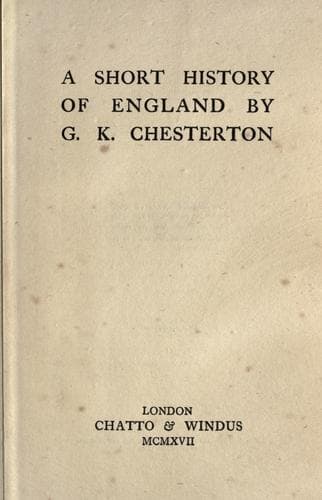
A Short History of EnglandChesterton, G. K. (Gilbert Keith)
History
A Short History of England
Chesterton, G. K. (Gilbert Keith)
Great Britain -- History
An indeterminate debate touching the dim races that mixed without record
in that dim epoch, has made much of the fact that the Norman edges of
France, like the East Anglian edges of England, were deeply penetrated
by the Norse invasions of the ninth century; and that the ducal house of
Normandy, with what other families we know not, can be traced back to a
Scandinavian seed. The unquestionable power of captaincy and creative
legislation which belonged to the Normans, whoever they were, may be
connected reasonably enough with some infusion of fresh blood. But if
the racial theorists press the point to a comparison of races, it can
obviously only be answered by a study of the two types in separation.
And it must surely be manifest that more civilizing power has since been
shown by the French when untouched by Scandinavian blood than by the
Scandinavians when untouched by French blood. As much fighting (and more
ruling) was done by the Crusaders who were never Vikings as by the
Vikings who were never Crusaders. But in truth there is no need of such
invidious analysis; we may willingly allow a real value to the
Scandinavian contribution to the French as to the English nationality,
so long as we firmly understand the ultimate historic fact that the
duchy of Normandy was about as Scandinavian as the town of Norwich. But
the debate has another danger, in that it tends to exaggerate even the
personal importance of the Norman. Many as were his talents as a master,
he is in history the servant of other and wider things. The landing of
Lanfranc is perhaps more of a date than the landing of William. And
Lanfranc was an Italian--like Julius Caesar. The Norman is not in history
a mere wall, the rather brutal boundary of a mere empire. The Norman is
a gate. He is like one of those gates which still remain as he made
them, with round arch and rude pattern and stout supporting columns; and
what entered by that gate was civilization. William of Falaise has in
history a title much higher than that of Duke of Normandy or King of
England. He was what Julius Caesar was, and what St. Augustine was: he
was the ambassador of Europe to Britain.
Public-domain text, read in full here on John Shaqi.
Reviews
Reviews
No reviews yet
Be the first to share your thoughts on this work.
Join the Discussion
Join the discussion
Sign in to leave a comment or review.
Sign InorCreate an account