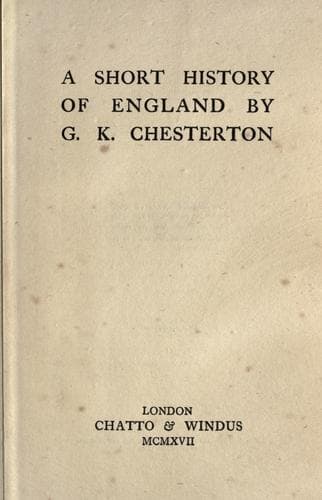
A Short History of EnglandChesterton, G. K. (Gilbert Keith)
History
A Short History of England
Chesterton, G. K. (Gilbert Keith)
Great Britain -- History
Now I will modestly maintain that I know more about English history than
this; and that I have as much right to make a popular summary of it as
the gentleman who made the crusader and the halberdier change hats. But
the curious and arresting thing about the neglect, one might say the
omission, of mediaeval civilization in such histories as this, lies in
the fact I have already noted. It is exactly the popular story that is
left out of the popular history. For instance, even a working man, a
carpenter or cooper or bricklayer, has been taught about the Great
Charter, as something like the Great Auk, save that its almost monstrous
solitude came from being before its time instead of after. He was not
taught that the whole stuff of the Middle Ages was stiff with the
parchment of charters; that society was once a system of charters, and
of a kind much more interesting to him. The carpenter heard of one
charter given to barons, and chiefly in the interest of barons; the
carpenter did not hear of any of the charters given to carpenters, to
coopers, to all the people like himself. Or, to take another instance,
the boy and girl reading the stock simplified histories of the schools
practically never heard of such a thing as a burgher, until he appears
in a shirt with a noose round his neck. They certainly do not imagine
anything of what he meant in the Middle Ages. And Victorian shopkeepers
did not conceive themselves as taking part in any such romance as the
adventure of Courtrai, where the mediaeval shopkeepers more than won
their spurs--for they won the spurs of their enemies.
I have a very simple motive and excuse for telling the little I know of
this true tale. I have met in my wanderings a man brought up in the
lower quarters of a great house, fed mainly on its leavings and burdened
mostly with its labours. I know that his complaints are stilled, and
his status justified, by a story that is told to him. It is about how
his grandfather was a chimpanzee and his father a wild man of the woods,
caught by hunters and tamed into something like intelligence. In the
light of this, he may well be thankful for the almost human life that he
enjoys; and may be content with the hope of leaving behind him a yet
more evolved animal. Strangely enough, the calling of this story by the
sacred name of Progress ceased to satisfy me when I began to suspect
(and to discover) that it is not true. I know by now enough at least of
his origin to know that he was not evolved, but simply disinherited. His
family tree is not a monkey tree, save in the sense that no monkey could
have climbed it; rather it is like that tree torn up by the roots and
named "Dedischado," on the shield of the unknown knight.
II
THE PROVINCE OF BRITAIN
Public-domain text, read in full here on John Shaqi.
Reviews
Reviews
No reviews yet
Be the first to share your thoughts on this work.
Join the Discussion
Join the discussion
Sign in to leave a comment or review.
Sign InorCreate an account