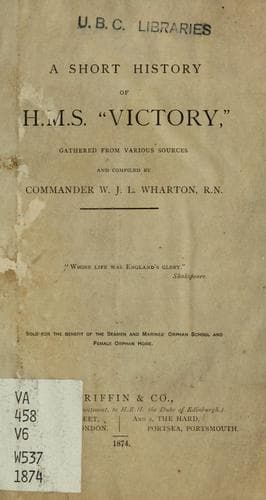
A Short History of H.M.S. VictoryWharton, W. J. L. (William James Lloyd)
History
A Short History of H.M.S. Victory
Wharton, W. J. L. (William James Lloyd)
Great Britain -- History, Naval; Victory (Ship)
The two ships arrived at Spithead on the 18th, when they were put in
quarantine for a day, to Nelson's great indignation; they were then
released, and Nelson went to his home at Merton, to get that rest he
so badly needed. The "VICTORY" remained at Spithead, and did what
repairs she could at that anchorage during her brief stay.
A short account of the proceedings of the combined fleets up to this
time, may tend to the elucidation of the state of affairs.
When Villeneuve made his escape from the Mediterranean, the Brest
squadron attempted to put to sea to join him at Martinique, but the
determined front put on by Lord Gardner, who commanded the Channel
fleet, then blockading Brest, daunted the enemy, who put back again
into port. This was failure number one, in Buonaparte's scheme.
We have followed Villeneuve with his 20 sail of French and Spanish
line-of-battle ships to Antigua; thence he proceeded for Brest,
intending to effect a junction with the fleet awaiting him there; but
on July 22nd, Sir Robert Calder, who was watching Ferrol and had been
warned by a frigate from Lord Nelson of the probable approach of the
enemy, met and engaged him, and though he numbered but 15 to 20, he
took two ships of the line, and forced the French admiral from his
design. This was the second breakdown in the programme; however,
Villeneuve got into Ferrol and joined the ships there, which made his
force 29 sail of the line, and with these he sailed on August 9th,
but, for some unexplained cause, instead of now making his way to
Brest, he turned south and entered Cadiz on the 21st, driving off
Admiral Collingwood's small squadron.
On September 2nd, Captain Blackwood, on his way to London with the
news of the combined fleets having left Ferrol, called at 5 a.m. at
Merton, where he found Lord Nelson up and dressed; the latter
immediately said, "you bring me news of the French and Spanish fleets,
I shall have to give them a drubbing yet;" and going up to town with
him, offered his services to the Admiralty. These were gladly
accepted, and the "VICTORY" again hoisted his flag on September
15th, and sailed the same day in company with the _Euryalus_, Captain
Blackwood, which frigate he afterwards despatched ahead to direct that
the "VICTORY" should not be saluted on her arrival, in order that
the enemy should be unaware of the reinforcement. On the 28th of the
same month he joined, and took command of, the fleet off Cadiz,
which, by the junction of Sir Robert Calder's ships to Admiral
Collingwood's now consisted of 29 sail.
On October 4th, Nelson dispatched Rear-Admiral Louis with 5 sail of
the line to Gibraltar, but a small squadron from England joined a few
days afterwards, making up his fleet to the following 27 sail of the
line.
104 { "VICTORY" { Vice-Admiral Lord Nelson, K.B.
{ { Capt. Thos. Masterman Hardy.
Public-domain text, read in full here on John Shaqi.
Reviews
Reviews
No reviews yet
Be the first to share your thoughts on this work.
Join the Discussion
Join the discussion
Sign in to leave a comment or review.
Sign InorCreate an account