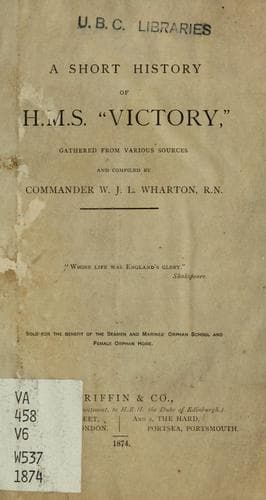
A Short History of H.M.S. VictoryWharton, W. J. L. (William James Lloyd)
History
A Short History of H.M.S. Victory
Wharton, W. J. L. (William James Lloyd)
Great Britain -- History, Naval; Victory (Ship)
{ _Royal Sovereign_ { Vice-Admiral Cuthbert Collingwood.
100 { { Captain Edward Rotheram.
{
{ _Britannia_ { Rear-Admiral Earl of Northesk.
{ { Captain Charles Bullen.
{ _Temeraire_ Captain Eliab Harvey.
{ _Prince_ Captain Richard Grindall.
98 { _Neptune_ Captain Thos. Francis Freemantle.
{ _Dreadnought_ Captain John Conn.
80 _Tonnant_ Captain Charles Tyler.
{ _Belleisle_ Captain William Hargood.
{ _Revenge_ Captain Robert Moorsom.
{ _Mars_ Captain George Duff.
{ _Spartiate_ Captain Sir Francis Laforey, Bart.
{ _Defiance_ Captain Philip Charles Durham.
{ _Conqueror_ Captain Israel Pellew.
{ _Defence_ Captain George Hope.
74 { _Colossus_ Captain James N. Morris.
{ _Leviathan_ Captain Henry W. Bayntun.
{ _Achille_ Captain Richard King.
{ _Bellerophon_ Captain John Cooke.
{ _Minotaur_ Captain Charles J. M. Mansfield.
{ _Orion_ Captain William Codrington.
{ _Swiftsure_ Captain William G. Rutherford.
{ _Ajax_ Lieut. John Pilfold.
{ _Thunderer_ Lieut. John Stockham.
{ _Polyphemus_ Captain Robert Redmill.
64 { _Africa_ Captain Henry Digby.
{ _Agamemnon_ Captain Sir Edward Berry.
Before continuing our narrative, we must again remind our readers that
this is but the history of one ship, and that in our account of
Trafalgar, only a sufficient general description of the movements of
the fleet will be given, to render the "VICTORY'S" part
intelligible; for details, we must again refer to _James's Naval
History_, where the most complete account of the action that has been
published, will be found.
On 19th October, the Franco-Spanish fleet, of 33 sail of the line,
under Admiral Villeneuve, as Commander-in-Chief, and Admiral Gravina,
(Spanish), as second, came out of Cadiz, and, after some manoeuvring,
at daylight on the 21st, the two fleets were in sight of one another,
being then about 20 miles west of Cape Trafalgar. The wind was light,
from the W.N.W., and the enemy were in a straggling line on the
starboard tack, under easy sail; the British fleet were in two columns
on the port tack, and some ten miles dead to windward. At 6.50, the
"VICTORY" made the signal to bear up, on which the enemy wore
together, thus presenting his port broadside to the English fleet,
which bore down with a very light wind right aft, and with all
studding sails set; the "VICTORY" leading the port line, and the
_Royal Sovereign_ the starboard, the latter being somewhat in advance.
Public-domain text, read in full here on John Shaqi.
Reviews
Reviews
No reviews yet
Be the first to share your thoughts on this work.
Join the Discussion
Join the discussion
Sign in to leave a comment or review.
Sign InorCreate an account