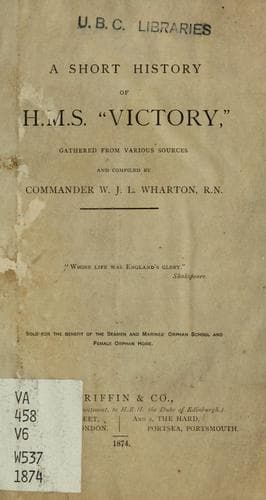
A Short History of H.M.S. VictoryWharton, W. J. L. (William James Lloyd)
History
A Short History of H.M.S. Victory
Wharton, W. J. L. (William James Lloyd)
Great Britain -- History, Naval; Victory (Ship)
On arriving on August 30th, off Rogerwick, he found the enemy safe
inside, and at once made preparations for an attack. On the 1st
September, in company with the _Goliath_, the "VICTORY" stood in to
reconnoitre, and having silenced a battery that engaged them, a good
view of the enemy's position was obtained, and the next day fixed for
the assault. Unfortunately, the next day broke with a gale of wind,
the ships were unable to move, and the storm lasting eight days, gave
the enemy time to bring troops from Revel, and to erect batteries on
all sides, making any attempt at attack hopeless. Sir James therefore,
after watching the port till September 30th, sailed for Carlscrona,
where he remained till winter warned him to depart for England. He
arrived in the Downs on 9th December, and at once struck his flag.
The operations in the Baltic in this, and the other four years in
which the "VICTORY" was flagship of Sir James Saumarez, were, as far
as she herself was concerned, mainly confined to political schemes and
transactions; the active work, such as it was, being done by the
frigates and gun-boats, many of which latter, however, were manned by
the "VICTORY'S" officers and men; the Russian fleet never came out
again, but remained shut up in Cronstadt, which was much too strong to
be attacked; thus the proceedings are of very little interest, and
beyond the fact of her being employed, we have little to record.
She went out almost immediately after the striking of Saumarez's flag
in 1808, as a private ship in the squadron which was dispatched to
Corunna to bring home the army of the unfortunate Sir John Moore, and
returned to Portsmouth on January 23rd. During this cruise she was
commanded by Captain Searle, but on her going round to Chatham for a
refit, Captain Dumaresq again returned to her, and Sir James Saumarez
re-hoisting his flag on April 8th, 1809, she once more sailed for the
Baltic, on the navigation being reported open. The best part of this
year was spent by the "VICTORY" and fleet of 10 sail, in blockading
the Russian ships in Cronstadt. One successful boat attack was made,
when 8 of the enemy's gun-boats were destroyed, but otherwise there
was no fighting. In the autumn, Sweden was forced to make peace with
Russia, on terms dictated by the latter, that would have doubtless
been harder, had not the presence of the British fleet prevented any
active employment of the Russian ships. The "VICTORY" returned to
the Downs by Christmas, and the Admiral struck his flag.
Public-domain text, read in full here on John Shaqi.
Reviews
Reviews
No reviews yet
Be the first to share your thoughts on this work.
Join the Discussion
Join the discussion
Sign in to leave a comment or review.
Sign InorCreate an account