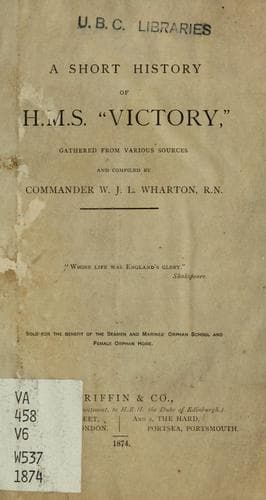
A Short History of H.M.S. VictoryWharton, W. J. L. (William James Lloyd)
History
A Short History of H.M.S. Victory
Wharton, W. J. L. (William James Lloyd)
Great Britain -- History, Naval; Victory (Ship)
On the 11th March, 1810, Saumarez resumed his command, and proceeded
to Hawke Roads, in Sweden, and thence to Hano Bay, near Carlscrona,
where he laid most of the year, having a ship or two watching the
Russians; but as they never ventured out, nothing was done, and
"VICTORY" sailed on 10th October, with 1000 sail of merchantmen
under her convoy. These were seen safely through the Belt, and Sir
James then remained with all his ships at Hawke Bay, as late as the
ice permitted him, to prevent the possibility of the Russian fleet
from the White Sea entering the Baltic. The Swedes about this time
were compelled by Napoleon to declare war with England, but the
feelings between the two countries were privately as friendly as
before. Hearing that the Archangel ships were laid up, Saumarez sailed
for England, and arriving on 3rd December, hauled down his flag.
The "VICTORY" then again made a trip to the coast of Portugal, this
time with the flag of Rear-Admiral Sir Joseph S. Yorke, who took a
squadron of 7 line-of-battle ships to Lisbon, with a reinforcement of
6500 men for Sir Arthur Wellesley, then blockaded in his intrenchments
at Torres Vedras by Massena; but she returned to the Nore in time to
hoist Sir James Saumarez's flag for the fourth year, on the 2nd April,
1811.
He proceeded to Wingo Sound, and there remained nearly the whole
year. The anomalous state of affairs between Sweden and ourselves
continued, and as public enemies and private friends we remained until
the end of the year, when Sweden concluded an alliance with England.
The "VICTORY'S" boats made various expeditions against the Danes,
and captured several gun-boats.
On December 18th, the fleet left Wingo for England; and on the 23rd a
gale arose, by which they were dispersed, and H.M.S. _St. George_ and
_Defence_ were wrecked on the western coast of Jutland, and the _Hero_
off the Texel; but the "VICTORY" and other ships weathered it in
safety, and anchored at St. Helen's on Christmas Day, when Sir James
struck his flag.
On April 14th, 1812, it was again hoisted, and on the 28th,
"VICTORY" sailed with a squadron of 10 sail of the line, and took
her station as usual at Wingo. The naval operations this year were
more active than before; the Danes had equipped a good many frigates
and small craft for attacks on the Swedish coast, and frequent
engagements took place between them and our smaller vessels; but
"VICTORY" was not herself in action. In October, orders were
received from England to send his flagship home, and on the 15th of
that month, Sir James shifted his flag to the _Pyramus_, and
"VICTORY" sailed for England, and arriving at Portsmouth, was paid
off in November.
Public-domain text, read in full here on John Shaqi.
Reviews
Reviews
No reviews yet
Be the first to share your thoughts on this work.
Join the Discussion
Join the discussion
Sign in to leave a comment or review.
Sign InorCreate an account