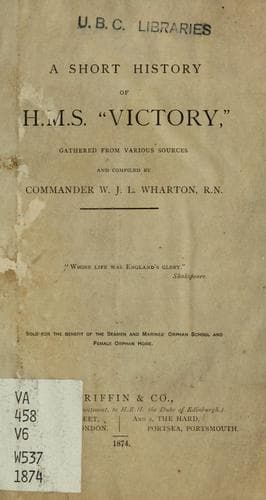
A Short History of H.M.S. VictoryWharton, W. J. L. (William James Lloyd)
History
A Short History of H.M.S. Victory
Wharton, W. J. L. (William James Lloyd)
Great Britain -- History, Naval; Victory (Ship)
This is the history of a ship, and not of the times, so we have
strictly nothing to do with subsequent events that arose out of this
engagement; but, as they created great excitement, perhaps a short
account of the sequel may not be altogether out of place. At this
period of our history, the British public expected some tangible
proofs of our naval superiority whenever our fleets met an equal
enemy, in the shape of ships captured or destroyed; and the indecisive
results of the action of the 27th July, gave rise to a multitude of
paragraphs in the newspapers, commenting on the conduct of the
different Admirals, especially that of the Commander-in-Chief, and Sir
Hugh Palliser, and attributing blame to one or the other, as their
fancy, or rather their politics dictated: the principals themselves
(who were both members of the House of Commons, but of opposite
parties), in exculpating themselves, became involved in mutual
recriminations, and finally Sir Hugh Palliser preferred charges
against Admiral Keppel, for, in a few words not doing his best to
"burn, sink, and destroy." Suffice it to say, that a Court Martial to
try Admiral Keppel met at Portsmouth on January 7th, 1779, and sat at
the Governor's house, by special Act of Parliament, on account of the
bad health of the accused, until February 11th, when it honourably
acquitted him, and declared the charges "malicious and ill-founded."
Keppel, by his former victories and frank condescending manners, had
long rendered himself the idol of the navy and people, and the first
disappointment felt at the meagre results of his engagement had been
succeeded by a strong popular reaction in his favour, when it was
understood that he would be placed on his trial. The news of his
acquittal was received throughout the country with an extraordinary
burst of joy. On the sentence being made known, a signal gun was fired
at Portsmouth, upon which the ships at Spithead immediately cheered
and saluted, and a fleet of Indiamen, lying at the Mother Bank, fired
19 vollies. Nor were they behind hand on shore in manifesting their
delight; the bells of Portsmouth church rang for the day, the late
prisoner was escorted from the court by a vast crowd, attended by some
of the most illustrious in the land; and such was his popularity, that
not only Portsmouth, but other towns were illuminated, and the
inhabitants rejoiced in the most frantic way, as if for a great
national deliverance.
Public-domain text, read in full here on John Shaqi.
Reviews
Reviews
No reviews yet
Be the first to share your thoughts on this work.
Join the Discussion
Join the discussion
Sign in to leave a comment or review.
Sign InorCreate an account