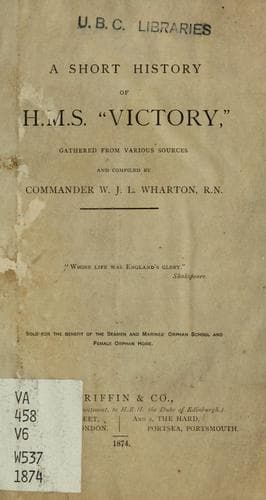
A Short History of H.M.S. VictoryWharton, W. J. L. (William James Lloyd)
History
A Short History of H.M.S. Victory
Wharton, W. J. L. (William James Lloyd)
Great Britain -- History, Naval; Victory (Ship)
Admiral Keppel was requested to retain the command of the fleet, but
refused, and was succeeded by Sir Charles Hardy, who hoisted his flag
in the "VICTORY," on the 19th March, 1779. Sir Charles found himself
with 37 ships of the line, which seems a large force, but the accounts
of the day state that a number of them were very badly manned; however
that may be, after sailing on June 16th, he was cruising off Ushant on
August 20th, when intelligence reached him that the French and Spanish
fleets had effected a junction at Cadiz, and were then off Plymouth;
he learnt also that they consisted of 67 sail of the line, besides
more than 30 frigates, and smaller vessels. Sir Charles made sail
after them, and sighted them on 1st September, off Scilly, when
finding that his information as to their force was correct, and
reflecting that the safety of the country would in a great measure
depend on him should the enemy attempt a landing, he retired to
Spithead. This is, we believe, the only time that the "VICTORY" was
ever forced to show her stern to an enemy.
The combined fleets, after making a great show, and indulging in a
parade off Plymouth, quitted the Channel without attempting any
enterprise. The British Admiral cruised till the end of the year, when
the "VICTORY" returned to Portsmouth with her division, and, being
placed in dock, was coppered for the first time. In the spring, whilst
preparing to take the sea again, Sir C. Hardy was seized with an
apoplectic fit, and died on 14th May, 1780.
Admiral Geary then hoisted his flag in the "VICTORY," on 24th May,
on succeeding to the command of the Channel fleet, and sailed early in
June, with 29 line-of-battle ships, 14 of them three-deckers. He
stationed himself off Brest, which he watched for three months, his
object being to prevent the French from getting out, and joining the
Spaniards fitting in Cadiz; when, having over 2500 sick on board his
fleet, he returned to Spithead on the 18th August. He captured a
valuable convoy of merchantmen during his cruise, but did not have a
chance of measuring his strength with the enemy. Feeling his health
failing, Admiral Geary resigned his command, and the "VICTORY"
struck his flag on the 28th August.
Vice-Admiral Darby, who was on board the _Britannia_, then took
command of the Channel fleet, and the "VICTORY" flew the flag of
Rear-Admiral Drake, the 3rd in seniority, but only for one cruise, as
being afflicted with severe attacks of gout, this officer resigned his
post on 29th December.
Public-domain text, read in full here on John Shaqi.
Reviews
Reviews
No reviews yet
Be the first to share your thoughts on this work.
Join the Discussion
Join the discussion
Sign in to leave a comment or review.
Sign InorCreate an account