A Short History of the 6th Division: Aug. 1914-March 1919 — John Shaqi
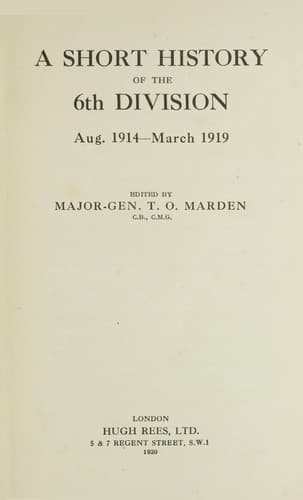
A Short History of the 6th Division: Aug. 1914-March 1919
History
A Short History of the 6th Division: Aug. 1914-March 1919
Great Britain. Army. Division, 6th; World War, 1914-1918 -- Campaigns -- Western Front; World War, 1914-1918 -- Regimental histories -- Great Britain
The attack was completely successful; all objectives were quickly
gained. A very large number of German dead were counted in the
recaptured position, and a considerable number of prisoners taken. The
captured position was subjected to a very heavy bombardment,
especially on the right; principally by guns firing from the
south-east, not opposite the corps front, which took the new line in
flank and often in reverse. The troops of the 18th Infantry Brigade
held on to their positions with their usual gallantry and
determination, in spite of very heavy casualties. The 2nd D.L.I.
particularly distinguished themselves by the tenacity they displayed,
and they and the 2nd Sherwood Foresters and 1st East Yorkshire
Regiment suffered severely. In face of the heavy shelling it was found
impossible on the right to establish a line on the final objective,
where all the former trenches had been entirely obliterated. The
advanced troops had accordingly to be withdrawn on this flank, but
some time after this withdrawal was thought to have been completed a
message was received from a Lance-Corporal of the 2nd D.L.I. to the
effect that he was established in the stables of the chateau with a
few men, and asking that rations and ammunition might be sent up to
them. On the left not only was all the ground lost on the 30th July
regained, but an important spur north of the Menin Road, which had
hitherto been in German occupation, was included in the final position
consolidated. Three officers and 124 other ranks were taken prisoners,
and over 500 of the enemy were counted dead on the captured ground.
The gallant work of the R.E. in wiring the position was specially
mentioned in the accounts from G.H.Q. which appeared in the papers.
The attack at Hooge was particularly interesting, as it was the first
attempt made to follow the barrage really closely. The barrage did
not, however, "creep" up to the German front line, but was placed
directly on it at once at zero and lifted back from there, the 6-in.
howitzers lifting slightly before the Field Artillery. The infantry
lay out as close to the barrage as possible before zero, and moved in
_on time_ as soon as the Field Artillery barrage lifted. The attack
was looked upon for some time as a model of really close co-operation
between infantry and artillery.
For this operation, skilfully planned and most gallantly and
successfully carried out, the Division received great praise. The
casualties were 70 officers and 1,700 other ranks. (A very full
account of this operation can be found in the fourth volume of _The
Great World War_, published by the Gresham Publishing Company,
Limited.)
Public-domain text, read in full here on John Shaqi.
Reviews
Reviews
No reviews yet
Be the first to share your thoughts on this work.
Join the Discussion
Join the discussion
Sign in to leave a comment or review.
Sign InorCreate an account