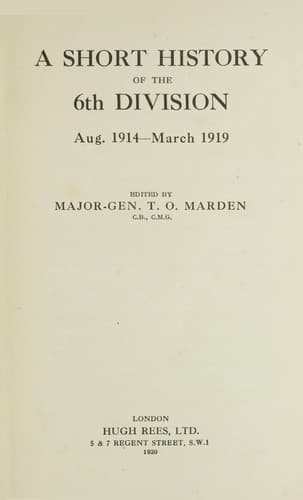
A Short History of the 6th Division: Aug. 1914-March 1919
History
A Short History of the 6th Division: Aug. 1914-March 1919
Great Britain. Army. Division, 6th; World War, 1914-1918 -- Campaigns -- Western Front; World War, 1914-1918 -- Regimental histories -- Great Britain
Other incidents of the tour in the Salient were the gallant voluntary
assistance rendered on the 6th July 1915 by Lieut. Smith, 1st North
Staffords (died of wounds), with his grenadier party to a post of the
41st Brigade which was being heavily attacked, and which brought him
the thanks of General Allenby, commanding V Corps; the enemy gas
attack of 19th December 1915, when no actual attack was launched
against the Division, and the minor operations near Turco Farm and
Morteldje Estaminet on 19th-22nd April 1916. Certain trenches, D20 and
21 and Willow Walk, were much overlooked by High Command Redoubt, some
150 yards away. The Germans throughout the 19th April heavily
bombarded these trenches, and succeeded in seizing them at night. One
company 8th Bedfords and two companies Y. and L. delivered a
counter-attack in the early hours of 20th April, but could not retake
the position. The Brigadier-General therefore decided to bombard them
steadily throughout the 21st, and recapture them on the night
21st/22nd April with three companies of the K.S.L.I., then in Brigade
Reserve. This was brilliantly accomplished in spite of the very heavy
going, and the line firmly re-established, but with the loss of
Lt.-Col. Luard, commanding K.S.L.I., who died of wounds. It was found
that the enemy had dug good new trenches in several places, and
equipped them with steel loop-hole plates, and these were occupied
thankfully by our men. The general state of the trenches, commanded as
they were by the enemy's positions, in the water-logged Ypres Salient
during the winter of 1915-1916 defies description, and all praise must
be given to the regimental officers and men for their hard work
and cheerfulness under most depressing conditions.
Mention must be made of the thirty-five-mile march to Croix Dubac to
assist in an extensive raid by the Anzac Corps, made by the 24th
Brigade, R.F.A., at the shortest notice. The brigade was away ten
days.
During this period the principal change which occurred in the Order of
Battle of the Division was the arrival of the 71st Infantry Brigade
(Brig.-Gen. M. Shewen) instead of the 17th Infantry Brigade, which
took the place of the former in the 24th Division. Consequent on this
was a redistribution of battalions to brigades--the 1st Leicestershire
Regiment, from the 16th Infantry Brigade, and the 2nd Sherwood
Foresters, from the 18th Infantry Brigade, being transferred to the
71st Infantry Brigade in exchange for the 8th Bedfordshire Regiment
and the 11th Essex Regiment respectively. These exchanges took
place--the former on the 18th November 1915, the latter on the 28th
October 1915. On 1st April the 11th Leicestershire Regiment (Pioneers)
joined from the United Kingdom.
Public-domain text, read in full here on John Shaqi.
Reviews
Reviews
No reviews yet
Be the first to share your thoughts on this work.
Join the Discussion
Join the discussion
Sign in to leave a comment or review.
Sign InorCreate an account