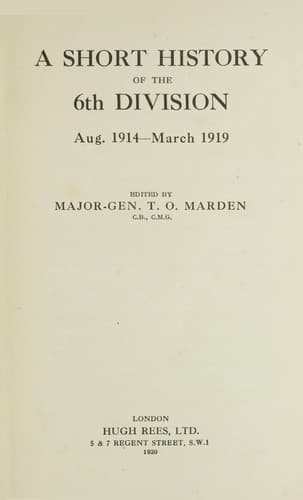
A Short History of the 6th Division: Aug. 1914-March 1919
History
A Short History of the 6th Division: Aug. 1914-March 1919
Great Britain. Army. Division, 6th; World War, 1914-1918 -- Campaigns -- Western Front; World War, 1914-1918 -- Regimental histories -- Great Britain
A second attack at 6 p.m. the same day succeeded in bringing our line
to about 250 yards from the Strong Point, and in getting touch on the
right with the 16th Infantry Brigade.
Preparations were now made to include the Quadrilateral in the
general attack of the 15th September instead of making it a subsidiary
operation--a situation which recurred two years later almost to a day
in the attack on Holnon Village, and which had similar results.
The British objective for the 15th September was
Gueudecourt-Flers-Lesboeufs-Morval--the XIV Corps (Guards and 6th
Division) to capture the two latter. It was the first occasion on
which tanks were employed, and as far as the Division was concerned
was a failure, for of the three allotted to the 6th Division two broke
down before starting, and the third, moving off in accordance with
orders long before the infantry, had its periscope shot off, its
peep-holes blinded, was riddled by armour-piercing bullets, and had to
come back without achieving anything. This again found a parallel in
the attack on the Quadrilateral, near St. Quentin, on 18th September
1918, when the tanks were ineffective.
To facilitate the movement of the tanks a gap of about 200 yards had
been left in the creeping barrage. This gap unfortunately coincided
with the strongest point of the Quadrilateral. The barrage, moreover,
had passed over the German trenches by the time the infantry advanced;
the latter had, consequently, to attack up the glacis-like slopes
without any artillery support except the bombardment. This, owing to
the enemy's trenches not having been accurately located, was
ineffective.
The 16th Infantry Brigade attacked on a battalion front--one company
of the Bedfords bombing up the trench from Leuze Wood, and the
remainder over the open to the north against the south-west face. The
Buffs and York and Lancasters supported the attack, but in spite of
the greatest gallantry could not take the Strong Point.
The 1st Leicesters and the Norfolks, passing through the entrenched
Foresters and Suffolks, attacked the Quadrilateral from the north-west
with equal drive, but they too failed. Some ground, however, was
made, and by 10 a.m. the 16th Infantry Brigade on the south, and the
71st Infantry Brigade on the north, were digging in close to the
enemy's wire and trenches.
Public-domain text, read in full here on John Shaqi.
Reviews
Reviews
No reviews yet
Be the first to share your thoughts on this work.
Join the Discussion
Join the discussion
Sign in to leave a comment or review.
Sign InorCreate an account