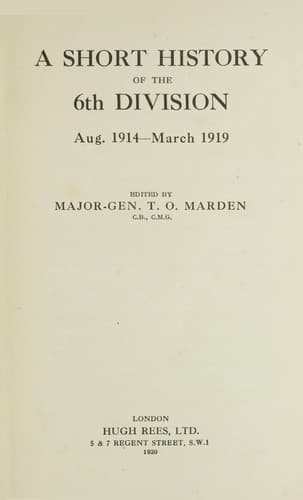
A Short History of the 6th Division: Aug. 1914-March 1919
History
A Short History of the 6th Division: Aug. 1914-March 1919
Great Britain. Army. Division, 6th; World War, 1914-1918 -- Campaigns -- Western Front; World War, 1914-1918 -- Regimental histories -- Great Britain
During the day constant reports arrived that the Guards had gained
their objectives, and that tanks and cheering men were moving through
Lesboeufs. It was not until the following morning that this report
was proved to be incorrect, and that it was Flers which had been
captured. In the meantime it appeared to the Divisional G.O.C.
(General Ross) that the prospect of a break-through on a large scale
was prejudiced solely by the repulse of the 6th Division. He therefore
ordered a night attack on the flanks of the Quadrilateral to be
executed by two battalions of the 18th Infantry Brigade (Brig.-Gen. R.
J. Bridgford). These battalions, the 2nd Durham Light Infantry and the
11th Essex, moved round after dark and attacked; the former from the
north, the latter from the south-east to the left of the 16th Infantry
Brigade. The 11th Essex lost direction, while the 2nd D.L.I. bombed
down a trench only to find that it did not lead into the Strong Point.
Except on the 6th Divisional front and at High Wood, which was
captured during the night, the whole line had advanced, and it was a
bitter blow to the Division to think that their sacrifices had been in
vain.
On the night of the 16/17th September the 18th Infantry Brigade
relieved the sorely-tried 71st Infantry Brigade, and fresh
preparations were made for an attack, on the 18th, of the
Quadrilateral, which had been strongly reinforced by the enemy through
the sunken road.
The K.S.L.I. dug themselves in with their left on the railway, so as
to assault the south-west face of the Strong Point. The weather having
cleared, the trenches were now carefully located from the air and
heavily bombarded, and on the 18th September, under both a stationary
and creeping barrage, and with the York and Lancasters bombing up
the trench from Leuze Wood, and the 18th Infantry Brigade (West Yorks
and 14th Durham Light Infantry) attacking the north-west face and the
trench running north from the Quadrilateral, this redoubtable Strong
Point was at last captured with comparatively small loss after what
must be conceded as a magnificent defence, and which had cost the
Division upwards of 3,500 casualties. Nine machine-guns and 160
unwounded prisoners were taken in the Quadrilateral and many Germans
killed.
Public-domain text, read in full here on John Shaqi.
Reviews
Reviews
No reviews yet
Be the first to share your thoughts on this work.
Join the Discussion
Join the discussion
Sign in to leave a comment or review.
Sign InorCreate an account