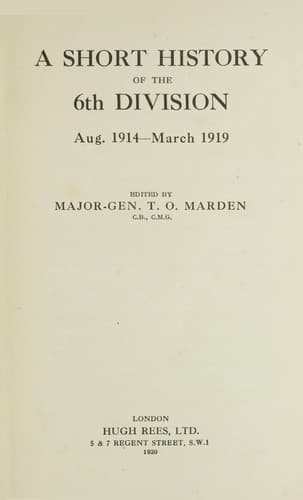
A Short History of the 6th Division: Aug. 1914-March 1919
History
A Short History of the 6th Division: Aug. 1914-March 1919
Great Britain. Army. Division, 6th; World War, 1914-1918 -- Campaigns -- Western Front; World War, 1914-1918 -- Regimental histories -- Great Britain
The Quadrilateral once captured, the advance was carried forward for
1,000 yards to within half a mile of Morval and Lesboeufs. These,
which were the original objectives on the 13th September, were now to
be attacked on the 25th September. Relieved for rest on the 16th, the
Division came in again on 21st September, and dug good assembly
trenches. The most forward portion of the line taken over by the
Division consisted of 250 yards of one of the main German trenches,
which was held by the Germans on both flanks for some distance.
Fortunately we were in possession of the communication trench leading
up to it, and during the three nights after taking over considerable
excitement and amusement were caused by the occasional arrival of
German ration parties at our part of the trench, having failed to hit
off the part occupied by their own troops. Uttering many guttural
oaths these fled for their lives, speeded up by our machine and Lewis
guns. A few prisoners were captured in this way, and some valuable
information obtained. Spurred on apparently by the loss of their
rations, the Germans attacked on the 24th September both flanks of
this trench under cover of a mist, but were driven back without
reaching it, except on the extreme right. Here they entered a bombing
post, but were ejected, leaving one officer and twelve other ranks
dead and an unwounded prisoner, while our casualties were practically
nil.
The objective allotted to the Division for the 25th September was the
ground between the north end of Morval (attacked by 5th Division)
and the road which passes through the centre of Lesboeufs. At 12.35
p.m. the attack was launched--the 16th Infantry Brigade on the right
gaining the first objective with the Buffs, and the final objective
with K.S.L.I. and the Y. and L. On the left the 2nd D.L.I. and the
Essex captured the first objective, and the West Yorks and two
companies 14th D.L.I. the final objective. This was one of the most
successful battles on the Somme--thanks to good weather and
observation, a carefully arranged creeping barrage, and a sound
preliminary bombardment.
The Division captured over 500 prisoners, 6 machine-guns, and 4 heavy
trench-mortars. Tanks were not used. We here turned the tables on the
52nd Division, 26th Reserve Corps, our old opponents at Ypres, where
the ground was all in their favour and where they had proved
troublesome antagonists.
After consolidating its ground the Division was relieved by the 20th
Division on 30th September, and the long struggle began for the
possession of the high ground overlooking the Bapaume-Le Transloy
Road.
Public-domain text, read in full here on John Shaqi.
Reviews
Reviews
No reviews yet
Be the first to share your thoughts on this work.
Join the Discussion
Join the discussion
Sign in to leave a comment or review.
Sign InorCreate an account