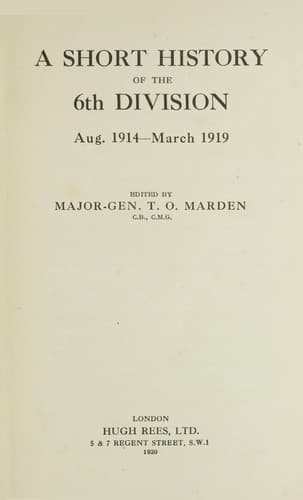
A Short History of the 6th Division: Aug. 1914-March 1919
History
A Short History of the 6th Division: Aug. 1914-March 1919
Great Britain. Army. Division, 6th; World War, 1914-1918 -- Campaigns -- Western Front; World War, 1914-1918 -- Regimental histories -- Great Britain
Six days later it commenced its march south to the Riencourt area, to
join the Third Army for the Battle of Cambrai.
The 11th Leicesters (Pioneers) had gone north to the II Corps, to work
on light railway construction near Dickebusch on 2nd July 1917. Their
absence was much felt by the Division, and in view of the approaching
operations they were welcomed back on 6th November, when they brought
with them a letter from G.O.C., II Corps (Lt.-Gen. Jacob)
congratulating them on their excellent work.
Before leaving the subject of the tour of the Division in the
Loos-Lens front, some reference ought to be made to the successes won
during that period by the Division in horse shows. After practically
sweeping the board in all events at the I Corps show for which it was
eligible to enter, the Division secured seven first and eight second
prizes at the First Army show, as well as the cup for the best R.A.
turn-out presented by G.O.C., R.A., First Army, and also that for the
best R.E. turn-out, presented by the C.E., First Army.
The Divisional Ammunition Column secured prizes for the two best teams
of mules, the best single mule, and the best light draught horse.
CHAPTER VIII
CAMBRAI
1917
The general situation on the British Western Front in November 1917,
though fairly universally known to-day, may now be outlined, and the
hopes and aims which led to the Cambrai offensive be touched on
shortly. The prolonged and hard-fought attacks in Flanders by the
British, and in other portions of the front by the French, had caused
the enemy to concentrate his forces in the threatened sectors,
denuding those portions of the line which appeared reasonably safe and
quiet. The Cambrai sector was included among the latter, for not only
was the ground very open, forbidding to us the unseen concentration of
the large forces and masses of heavy artillery which at that period
were deemed essential, but also the Hindenburg Line was immensely
strong and the trenches so wide that the tanks in use by us could not
cross them.
This enemy sector was, therefore, particularly suitable for surprise
by us, as it was deemed by the enemy to be unassailable.
The Hindenburg Line ran north-west for six miles from the St. Quentin
Canal at Banteux to Havrincourt on the Canal du Nord, where it bent
sharply north for four miles to Moeuvres, thus making a pronounced
salient. The Commander-in-Chief's plan was to smash the salient, to
occupy the high ground overlooking Cambrai--notably the Bourlon Wood
Ridge--push cavalry through the gap in order to disorganise
communications and the arrival of reinforcements, and to roll up the
enemy's defences to the north-west.
Public-domain text, read in full here on John Shaqi.
Reviews
Reviews
No reviews yet
Be the first to share your thoughts on this work.
Join the Discussion
Join the discussion
Sign in to leave a comment or review.
Sign InorCreate an account