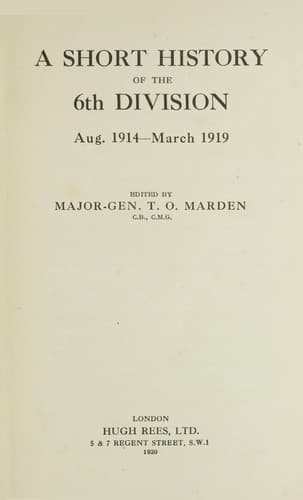
A Short History of the 6th Division: Aug. 1914-March 1919
History
A Short History of the 6th Division: Aug. 1914-March 1919
Great Britain. Army. Division, 6th; World War, 1914-1918 -- Campaigns -- Western Front; World War, 1914-1918 -- Regimental histories -- Great Britain
The French held considerable forces in the immediate vicinity
to exploit successes. It was reckoned that the enemy could not
reinforce his front under forty-eight hours. Everything depended in
the first instance on successful surprise, and in the second on
securing within forty-eight hours the important tactical points within
the salient. The difficulties of surprise, which were many and
serious, were most successfully overcome, but the enterprise failed
eventually because the key points were not seized.
The principal factors operating against success were the limited hours
of daylight and the long distances to be traversed both by men and by
tanks, which, though vastly improved since 1916, were still very slow.
There was also, in the case of securing the high ground west of
Cambrai, the canal to be crossed by tanks. While smashing in the
enemy's salient we ourselves were making a salient, extending our
front, as far as the Third Army was concerned, from a straight 7,000
yards to a curving 15,000 yards, thus affording the enemy a chance of
a blow at the sides and hinges of the salient, of which he availed
himself to good purpose ten days after our initial attack.
To ensure success the troops which were to undertake operations
practised with tanks in back areas, and officers and men went through
the operation on a carefully made ground model without being aware
what ground it represented. Units were brought up just before the 20th
of November, the day of the attack, marching by night and hiding in
villages and woods by day. In some cases battalions were quartered in
flat canvas erections, looking like ammunition or supply dumps. The
6th Division were fortunate in being in woods and destroyed villages.
No unusual activity on ground or in the air was allowed, no guns
registered as had been usual, even the Home mails were stopped for a
short period, and a screen of the troops which had held the line for
some time was kept in front trenches to the last. Under General Byng's
initiative the difficulty of tanks crossing the wide Hindenburg
Line trenches was overcome by each tank carrying on its brow a huge
faggot which it deposited in the trench at its selected crossing-place,
and which gave its tail a purchase to enable it to climb the opposite
side of the trench. The ground was very suitable for tanks, as it was
moderately hard grass land, and the first portion of the attack on
much of the front was downhill.
Public-domain text, read in full here on John Shaqi.
Reviews
Reviews
No reviews yet
Be the first to share your thoughts on this work.
Join the Discussion
Join the discussion
Sign in to leave a comment or review.
Sign InorCreate an account