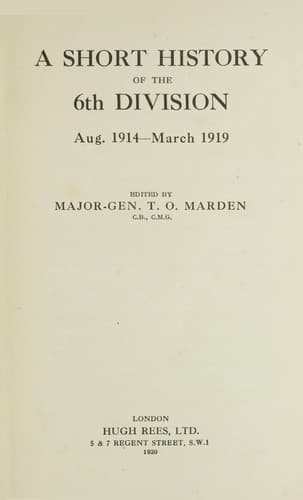
A Short History of the 6th Division: Aug. 1914-March 1919
History
A Short History of the 6th Division: Aug. 1914-March 1919
Great Britain. Army. Division, 6th; World War, 1914-1918 -- Campaigns -- Western Front; World War, 1914-1918 -- Regimental histories -- Great Britain
The III Corps (Lt.-Gen. Sir W. Pulteney) was on the right, and
consisted of the 12th, 20th, and 6th Divisions, which attacked in the
order named. The left corps (IV) consisted of the 51st and 62nd
Divisions. These covered the six miles with an average frontage of one
and a half miles. The 6th Division attacked on the front Villers
Plouich-Beaucamps, with the 71st Infantry Brigade (Brig.-Gen. P. W.
Brown) on the left next to the 51st Division, the 16th Infantry
Brigade (Brig.-Gen. H. A. Walker) on the right next to the 20th
Division. These two brigades were to advance about 3,000 yards to the
first objective (Ribecourt and spur to south-east of it), and another
1,000 yards to the second objective (support system). The 18th
Infantry Brigade (Brig.-Gen. G. S. G. Craufurd) was ordered to advance
through the 71st Infantry Brigade and secure the third objective about
a mile farther on (Premy Chapel Ridge), throwing back a defensive
flank towards Flesquieres for the further operations of the 51st
Division on its left and securing the flank of the 29th Division on
its right. The latter division passing through the right of the 6th
Division and the left of the 20th Division, was charged with securing
the crossings of the St. Quentin Canal at Marcoing and Masnieres and
seizing the high ground at Rumilly, thus facilitating exploitation to
the south-east, preventing a concentration against the widely
stretched defensive flanks of the III Corps and threatening Cambrai.
The Divisional Artillery was reinforced during the first part of the
operations by the 17th Brigade of the 29th Division and the 181st
Brigade of the 40th Division, as well as by two R.H.A. Brigades.
Batteries moved into position and camouflaged their guns. No
registration could, of course, take place, but long practice enabled
the gunners to put down a very accurate barrage without this
desideratum.
Opposite the Division the Hindenburg Line commenced with an outpost
line 750 yards distant on the left and 250 yards on the right. This
was out of sight of our front trenches by reason of the curve of the
ground. Half a mile behind this came the main system, consisting of
two trenches 200 yards apart, the whole guarded by most formidable
belts of wire about 150 yards in depth. The interval between outpost
and main systems was sown with well-sighted and concealed machine gun
positions. A mile farther on, and on the opposite side of the valley
for the most part, ran the support system, similar to the main system.
One and a half miles farther back again was the reserve system, of
which only machine-gun dug-outs were completed, and a small amount of
wire had been erected.
Public-domain text, read in full here on John Shaqi.
Reviews
Reviews
No reviews yet
Be the first to share your thoughts on this work.
Join the Discussion
Join the discussion
Sign in to leave a comment or review.
Sign InorCreate an account