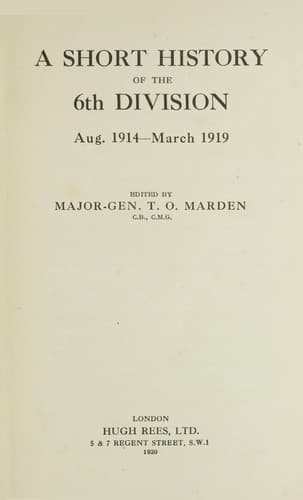
A Short History of the 6th Division: Aug. 1914-March 1919 — John Shaqi
A Short History of the 6th Division: Aug. 1914-March 1919
History
A Short History of the 6th Division: Aug. 1914-March 1919
Great Britain. Army. Division, 6th; World War, 1914-1918 -- Campaigns -- Western Front; World War, 1914-1918 -- Regimental histories -- Great Britain
Two companies of the 8th Bedfords now reinforced the 14th D.L.I., and
this force again counter-attacked and recovered the bridge-head at
dusk; the 88th Infantry Brigade, assisted by 2nd Y. and L., having
also counter-attacked successfully south of the canal. Losses were,
however, heavy, and the line was gradually withdrawn under Corps
orders during the next two days to the Hindenburg support system,
which became our front line. The 14th D.L.I. fought magnificently,
losing 15 officers and 262 other ranks, more than half being killed.
Capt. Lascelles, who led two of the counter-attacks and was twice
wounded, here gained his V.C. The 16th M.G.C., both north and south of
the canal, had very heavy losses, but put up a splendid resistance.
The only other incidents of note were the repulse by the 18th Infantry
Brigade of a half-hearted enemy attack on Cantaing on the 1st
December, and D.H.Q. being three times shelled out of its Headquarters
between 30th November and 9th December.
During the whole period--20th November to 6th December--the Divisional
Artillery were constantly changing position in order to support the
infantry, either in advance or retirement, as closely as possible. It
was a welcome change to them after the many weary months of position
warfare, and it may be said, without fear of contradiction, that both
brigades and batteries were extremely ably handled, and that the
D.A.C. never left a battery short of ammunition, in spite of very long
distances and rough going.
On 10th December the Division (less artillery) was withdrawn to rest
in the Basseux area south-west of Arras, after a strenuous three
weeks.
The Divisional Artillery remained in action, covering the 18th
Division. A little later the 2nd Brigade, R.F.A., was withdrawn to
rest, but the 24th Brigade, R.F.A., continued in the line.
CHAPTER IX
GERMAN OFFENSIVE OF MARCH 1918
1918
After a month's rest in the Basseux area, during the first few days of
which the 16th and 18th Infantry Brigades were placed at the disposal
of the 3rd Division to relieve two of their brigades on the Bullecourt
front, the Division moved up, commencing on the 17th January to
relieve the 51st Division in the front line between Hermies and
Boursies. A month later it side-stepped northwards, relieving the 25th
Division in the Lagnicourt sector. The period up to the 21st March was
one of steady work on defences, but without special incident, except a
gas-shell attack on the 71st Brigade, which caused a certain amount of
casualties.
During this period Infantry Brigades were reduced to three battalions
each--the 9th Suffolk Regiment, 8th Bedford Regiment, and 14th Durham
Light Infantry being disbanded between 1st and 16th February. Shortly
afterwards the three Machine-gun Companies and the Divisional
Machine-gun Company were organized into the 6th Machine-gun Battalion,
under the command of Lt.-Col. Rosher, D.S.O., late commanding 14th
D.L.I.
Public-domain text, read in full here on John Shaqi.
Reviews
Reviews
No reviews yet
Be the first to share your thoughts on this work.
Join the Discussion
Join the discussion
Sign in to leave a comment or review.
Sign InorCreate an account