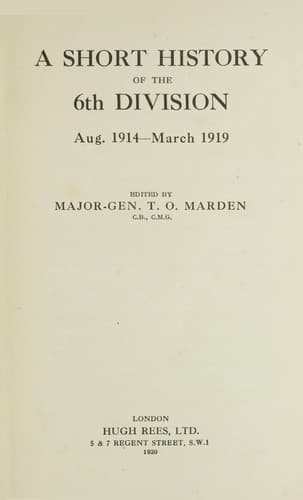
A Short History of the 6th Division: Aug. 1914-March 1919
History
A Short History of the 6th Division: Aug. 1914-March 1919
Great Britain. Army. Division, 6th; World War, 1914-1918 -- Campaigns -- Western Front; World War, 1914-1918 -- Regimental histories -- Great Britain
Some description of the ground and defensive organization of the
Division will not be out of place here. The front held by the Division
was generally on a forward slope opposite the villages of Queant and
Pronville.
No Man's Land averaged three-quarters of a mile in width. The whole
area was downland, and very suitable for the action of tanks. The
position lay astride a succession of well-defined broad spurs and
narrow valleys (like the fingers of a partially opened hand), merging
into the broad transverse valley which separated the British line
from the two villages above-mentioned. All the advantages of ground
lay with the defence, and it seemed as if no attack could succeed,
unless by the aid of tanks. A large portion of the front line--notably
the valleys--was sown with 2-in. trench-mortar bombs with instantaneous
fuses, which would detonate under the pressure of a wagon but not of a
man's foot. In addition five anti-tank 18-pounder guns were placed in
positions of vantage. The wire was very broad and thick. The position
would, indeed, have been almost impregnable had there been sufficient
time to complete it, and had there been separate troops for
counter-attack.
The ground was a portion of that wrested from the enemy in the Cambrai
offensive of November-December 1917, but had only improvised trenches.
A month's hard frost in January had militated against digging, and
though there were a complete front trench and reserve trench, the
support trenches hardly existed, and dug outs were noticeable by their
absence. The front was 4,500 yards in extent, the three brigades in
line--18th on right, 71st in centre, 16th on left--on approximately
equal frontages. The depth from front or outpost zone to reserve or
battle zone was about 2,000 yards. With only three battalions in a
brigade, there was no option but to assign one battalion in each
brigade to the defence of the outpost zones, and keep two battalions
in depth in the battle zone. With battalions at just over
half-strength, and with the undulating nature of the ground, the
defence resolved itself everywhere into a succession of posts with a
very limited field of fire.
A good corps line called the Vaux-Morchies Line had been dug, the
nearest portion a mile behind the reserve line, and this was held by
the Pioneers and R.E., owing to scarcity of numbers.
The Right Group, R.F.A. (Lt.-Col. H. Weber), consisting of 2nd Brigade
(less 21st Battery), supported the 18th Infantry Brigade; the Left
Group (Lt.-Col. J. A. C. Forsyth), consisting of 24th Brigade, 21st
Battery, and 93rd (Army) Brigade, supported the 16th and 17th Infantry
Brigades.
Public-domain text, read in full here on John Shaqi.
Reviews
Reviews
No reviews yet
Be the first to share your thoughts on this work.
Join the Discussion
Join the discussion
Sign in to leave a comment or review.
Sign InorCreate an account