A Short History of the 6th Division: Aug. 1914-March 1919 — John Shaqi
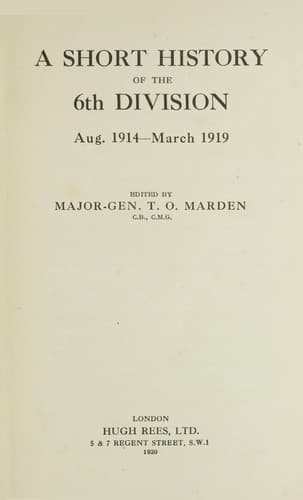
A Short History of the 6th Division: Aug. 1914-March 1919
History
A Short History of the 6th Division: Aug. 1914-March 1919
Great Britain. Army. Division, 6th; World War, 1914-1918 -- Campaigns -- Western Front; World War, 1914-1918 -- Regimental histories -- Great Britain
The 2nd West Yorks, reinforced by two companies 11th Essex, gallantly
led by Lt.-Col. Boyall, D.S.O., who was subsequently wounded and
captured, drove back three attacks issuing from our support line. The
18th Infantry Brigade held on till 7 p.m. when, in trying to withdraw,
it suffered heavy casualties. The last company was not overwhelmed
till 8.30 p.m. The 18th and 71st Infantry Brigades, therefore,
maintained their hold on the ground Lagnicourt and the Morchies Valley
all day, though the enemy had penetrated far in rear on both flanks.
When darkness fell the remnants of the Division were back in the corps
line, together with three battalions of the 75th Infantry Brigade
(25th Division), the remaining troops of the Division not being
strong enough to hold the line unaided. The 11th Cheshires were with
18th Infantry Brigade, 2nd South Lancs with 71st Infantry Brigade, and
8th Border Regiment with 16th Infantry Brigade.
The night was quiet, both sides preparing for the next day's struggle.
At 7.30 a.m. on 22nd March the 16th Infantry Brigade repulsed an
attack, but the enemy renewed his efforts with great persistence, and
with much heavy bombardment and trench-mortaring, at 9.30 a.m. and
onwards in the vicinity of Vaux and Mericourt Woods. Though frequent
counter-attacks were made, the troops were forced back little by
little from the corps line towards some improvised trenches hastily
dug under the C.R.E.'s (Col. Goldney) direction some 1,000 yards in
rear, and manned partially by men from the Corps Reinforcement Camp
under Major Jones of the 2nd D.L.I. As an example of the tenacious
fighting, a sunken road which contained the Headquarters of the 16th
and 71st Infantry Brigades changed hands three times. Throughout the
day Lt.-Col. Latham, D.S.O., commanding 1st Leicesters, and Lt.-Col.
Dumbell, D.S.O., commanding 11th Battalion Essex Regiment,
distinguished themselves greatly in the defence of their sectors of
the line. On the right of the Division the control had passed by dusk
to the G.O.C., 75th Infantry Brigade (29th Division)--the 18th
Infantry Brigade having only about 100 of all ranks left. On the left
there was a large gap between the 16th Infantry Brigade and the 40th
Division, which had been pushed up towards Vaux Vraucourt, and this
the 6th Division had no troops with which to fill it. The enemy's
pressure on the flanks of the 16th Infantry Brigade and in the centre
on the 71st Infantry Brigade caused the line to fall back on the new
Army line which was being dug and wired. This was done in good order,
and at nightfall the weary remnants of the Division were relieved by
the 41st Division and concentrated in the vicinity of Achiet, the
artillery remaining behind and fighting in the subsequent
withdrawal up to 26th March.
The Division had put up a resistance of which it had every reason to
be proud, and which won for it the following letter from the G.O.C.,
Third Army (General Sir J. Byng):--
Public-domain text, read in full here on John Shaqi.
Reviews
Reviews
No reviews yet
Be the first to share your thoughts on this work.
Join the Discussion
Join the discussion
Sign in to leave a comment or review.
Sign InorCreate an account