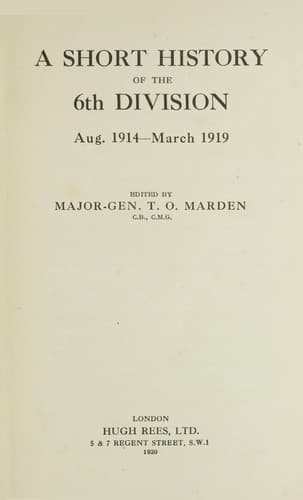
A Short History of the 6th Division: Aug. 1914-March 1919
History
A Short History of the 6th Division: Aug. 1914-March 1919
Great Britain. Army. Division, 6th; World War, 1914-1918 -- Campaigns -- Western Front; World War, 1914-1918 -- Regimental histories -- Great Britain
Reports from deserters that we were to be heavily attacked were
persistent, and the Division stood to arms twice before 21st March. On
20th March aeroplane photos disclosed ammunition pits for seventy
extra batteries opposite the divisional front, and when at 5 a.m. on
21st March the bombardment commenced, there was no doubt but that a
real offensive had begun. Warning had been given overnight for all
troops to be in battle positions by 5 a.m., but it came too late to
stop working parties, and the reserve battalions of all brigades had
marched ten miles before the battle commenced.
Fog favoured the Germans in that it prevented us seeing when the
attack was launched, but every credit must be given them for the skill
they evinced and the dash with which they pushed forward and brought
up successive waves of attackers. By concentrating their efforts on
the three main valleys, i.e. Noreuil Valley on our extreme left,
Lagnicourt Valley in the centre and Morchies Valley on our extreme
right, they avoided much of the fire which they would have encountered
on the broad spurs, and thus worked round and isolated the garrisons
of the latter. For five hours the bombardment continued with
tremendous force, first with gas and H.E. on back areas to cut
communications and disorganize reinforcements, later about 7 to 8 a.m.
with smoke and H.E. on the forward system. The intensity of it may be
gauged by the fact that four out of five concealed anti-tank guns were
knocked out by direct hits.
This bombardment annihilated the garrisons of the forward system, and
few survivors came back to the reserve line.
The only authenticated accounts of a successful resistance in the
front system were from the 71st Infantry Brigade, where both 9th
Norfolks and 2nd Sherwood Foresters repulsed the first attack. By
10.30 a.m. the enemy had nearly reached Noreuil and had driven back
the 59th Division on our left, leaving the left flank of the 16th
Infantry Brigade in the air, while its right flank went shortly
afterwards, as the enemy captured Lagnicourt, driving in the Sherwood
Foresters in the valley. The 16th Infantry Brigade was gradually
squeezed out towards the corps line, where at 4 p.m. parties from the
Divisional Bombing School counter-attacked and drove the enemy out of
trenches on the immediate left. The 71st Infantry Brigade, with its
right flank secure, threw back a defensive flank south-west of
Lagnicourt, and successfully prevented issue from that village to the
high ground. The enemy broke into Skipton Reserve Strong Point, but
were thrown out again by a counter-attack of Norfolks and Leicesters.
Coming up a subsidiary valley the enemy nearly drove a wedge between
71st and 18th Infantry Brigades, but the 2nd D.L.I. counter-attacked
gallantly and kept them out till dusk. On the right of the 18th
Infantry Brigade, however, the enemy advanced up the Morchies Valley,
capturing the left trenches of the 51st Division on our right at about
10 a.m.
Public-domain text, read in full here on John Shaqi.
Reviews
Reviews
No reviews yet
Be the first to share your thoughts on this work.
Join the Discussion
Join the discussion
Sign in to leave a comment or review.
Sign InorCreate an account