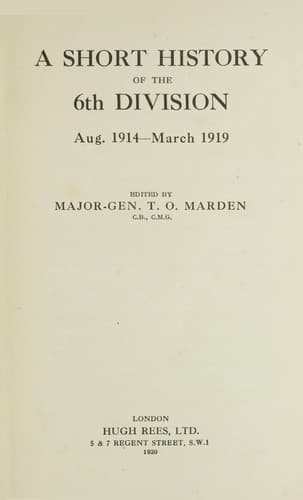
A Short History of the 6th Division: Aug. 1914-March 1919
History
A Short History of the 6th Division: Aug. 1914-March 1919
Great Britain. Army. Division, 6th; World War, 1914-1918 -- Campaigns -- Western Front; World War, 1914-1918 -- Regimental histories -- Great Britain
The morning of the 23rd March found the remnants of the Division,
less artillery, assembled about Achiet-le-Grand and Bihucourt. The
survivors of the 18th Infantry Brigade numbered 8 officers and 110
other ranks; those of the 71st Infantry Brigade 11 officers and 279
other ranks. Each of these brigades had had a trench strength on the
morning of the 21st of just over 1,800 all ranks. Figures for the 16th
Infantry Brigade are not available. The Division was most fortunate in
having very few senior officers killed, though many were wounded. The
most noticeable casualties among the killed were Major Lyon, 2nd
Brigade, R.F.A., Majors Williamson and Wingate, D.S.O., M.C., R.E.,
and Capt. Harbottle, M.C., 1st Leicesters.
Even after relief the Division was not able to enjoy the rest it had
so richly deserved, and of which it stood so much in need. The further
progress of the enemy's attack and constant alarms necessitated its
preparing and taking up a position of readiness covering Achiet,
throughout the 23rd and the 24th.
On the 25th March it entrained for the north, to join the Second Army
in its old haunts in the Ypres Salient.
CHAPTER X
YPRES SALIENT AGAIN
1918
On the 30th March, whilst in rest in the neighbourhood of Steenvoorde,
the Division had the honour of a visit from His Majesty the King.
Representative survivors of all ranks from the recent fighting were
drawn up in the square and were inspected by His Majesty, who spoke
most graciously to every individual, questioning all as to their
experiences during the fighting, and thanking them for and
congratulating them on their services.
At the beginning of April the 16th and 18th Infantry Brigades took
over the front from Broodseinde southwards to Polygon Wood, coming
under the XXII Corps (Lt.-Gen. Sir A. Godley).
The general situation now was that the Flanders front was held by
tired and decimated Divisions withdrawn from the big battle in the
south. These had been brought up to a respectable strength by drafts
from all sources--wounded men belonging to other formations, R.A.S.C.,
Labour Battalions, etc., many of whom had received no training in
infantry weapons or methods of fighting. Officers and men were new to
each other, and there was no chance to train as the whole of every
Division was in trenches.
Against these forces the Germans now opened a determined offensive
from Zandvoorde southwards.
On the 13th April, as a result of the German successes on the Lys, the
71st Infantry Brigade, which was in reserve, had to be rushed off to
join the 49th Division on the Neuve Eglise front. It returned to the
Division on the 26th April after a pretty rough time, during which
it suffered considerable casualties (about 750), but earned great
praise. A counter-attack delivered by the 9th Norfolk Regiment was a
particularly creditable incident in this period.
Public-domain text, read in full here on John Shaqi.
Reviews
Reviews
No reviews yet
Be the first to share your thoughts on this work.
Join the Discussion
Join the discussion
Sign in to leave a comment or review.
Sign InorCreate an account