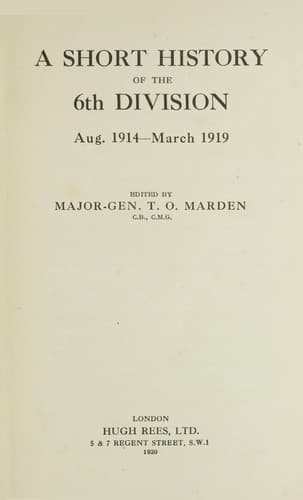
A Short History of the 6th Division: Aug. 1914-March 1919
History
A Short History of the 6th Division: Aug. 1914-March 1919
Great Britain. Army. Division, 6th; World War, 1914-1918 -- Campaigns -- Western Front; World War, 1914-1918 -- Regimental histories -- Great Britain
Otherwise the first fortnight in the Salient was without special
incident. On the 16th April, in consequence of the progress made by
the enemy farther to the south, the Salient was reduced in accordance
with plan, and the line withdrawn to the battle zone, where an
advanced force was left out in a line of detached pill-boxes and
works. The enemy followed up cautiously in the afternoon, but the
garrisons of the line of posts by lying low were able in several cases
to catch parties unawares, and a fair number of casualties were
inflicted. One party of twenty-five in particular was annihilated.
On the 25th April the enemy attacked and captured Kemmel Village and
Hill from the French. This decided the Higher Command to withdraw the
advanced force, and this was successfully carried out on the night of
the 26/27th to the line West end of Zillebeke Lake-White Chateau.
Incessant work on the new defences, and heavy shelling, particularly
gas shelling of Ypres, were the only incidents for some time on the
actual front of the Division, though heavy attacks on the 29th April
on the Division on the right, and the enemy's unsuccessful attack on
Ridgewood on the 8th May, kept it on the alert. The Division was on
the edge of the battle, and stood to on several occasions for an
attack on its own front.
On the 11th to the 14th May the Division side-slipped to the south in
relief of the 19th Division, thus coming next door to the 14th French
Division, and passing to II Corps (Lt.-Gen. Sir C. Jacob). On the 28th
May the enemy attacked our neighbours on the right and succeeded in
driving them out of Ridgewood and almost in reaching Dickebusch Lake.
In view of the importance to us of the lost position, and of the
exhausted state of the 14th (French) Division, an offer was made
to co-operate with them in a counter-attack to regain the lost ground.
This was gladly accepted, and on the early morning of the 29th May the
11th Essex Regiment attacked in conjunction with two battalions of
Chasseurs of the 46th (French) Division, which was in process of
relieving the 14th Division, the operation taking place under the
orders of the G.O.C., 14th French Division (General Philipot, the
conqueror of Fez).
Under a barrage formed by the French and English artillery the 11th
Essex Regiment attacked with great determination, and by the end of
the day had achieved the whole of its share of the task. The two
battalions of the Chasseurs were, unfortunately, not so successful,
with the result that the right of the 11th Essex Regiment was exposed,
and it was unable to hold on to a small part of the ground recovered
on its extreme right. For this action the Division received a letter
of thanks for its "spontaneous" co-operation from General de Mitry,
commanding the French Detachement de l'Armee du Nord.
Public-domain text, read in full here on John Shaqi.
Reviews
Reviews
No reviews yet
Be the first to share your thoughts on this work.
Join the Discussion
Join the discussion
Sign in to leave a comment or review.
Sign InorCreate an account