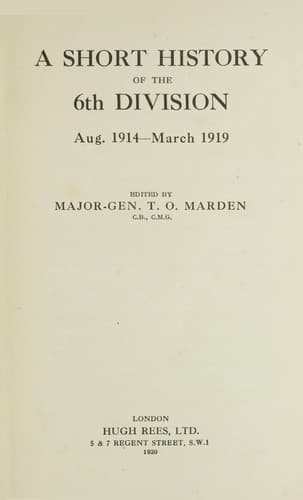
A Short History of the 6th Division: Aug. 1914-March 1919
History
A Short History of the 6th Division: Aug. 1914-March 1919
Great Britain. Army. Division, 6th; World War, 1914-1918 -- Campaigns -- Western Front; World War, 1914-1918 -- Regimental histories -- Great Britain
At dawn on the 20th September, the enemy delivered a heavy attack on
the I Corps and on the French left, driving in the Tirailleurs
d'Afrique and turning the flank of the West Yorks. The echeloned
company formed front to the flank, and the supporting company followed
suit. The Germans annihilated the right front company, and, using the
white flag ruse, apparently captured some of the next company. Major
Ingles, collecting a proportion of the front companies, withdrew a
short distance and counter-attacked, but was unsuccessful and lost his
life in this gallant endeavour. At about 1 p.m. a counter-attack was
delivered by the Sherwood Foresters, who were in Brigade Reserve, the
support company of the West Yorks, under Lt.-Col. Towsey, and a
squadron of the 18th Hussars from Paissy. These, advancing over the
perfectly open ground, recaptured the trenches and gallantly held them
against further attacks. In this affair the West Yorks suffered
casualties amounting approximately to 15 officers and 600 other ranks,
the Sherwood Foresters also losing 12 officers and 180 other ranks.
The temporary loss of the trenches by the West Yorks exposed the
trenches of the D.L.I, to enfilade machine-gun fire, from which they
had considerable casualties, including Majors Mander and Robb. This
was the only serious fighting in which the Division was engaged, but a
certain amount of trouble was caused by the arrival of guns from
Antwerp which fired "Black Marias," and the enfilade gun and
machine-gun fire to which portions of the main line lent themselves.
On the 21st September the 17th Infantry Brigade (Brig.-Gen. W. R. B.
Doran) relieved the 6th Infantry Brigade and the 4th Guards Brigade on
the front Fort de Metz-La Cour de Soupir, and held the portion without
much incident till 2nd October, when they were withdrawn into
Corps Reserve.
The 16th Infantry Brigade (Brig.-Gen. E. C. Ingouville-Williams)
relieved the 7th and 9th Infantry Brigades to the north-east of Vailly
on the 21st/22nd September, and remained in trenches until 12th
October, some time after the rest of the Division had gone north. They
received the thanks of the II Corps for their soldierly conduct. The
divisional artillery (Brig.-Gen. W. H. L. Paget) was in support of the
5th Division opposite Missy, but only the 2nd Brigade was engaged. It
had already been re-organized since mobilization by the inclusion, in
each of 12th, 24th and 38th Brigades, of a battery of 4.5-in.
howitzers.
The Battle of the Aisne marked the commencement of trench warfare, and
the Royal Engineers (Lt.-Col. G. C. Kemp, C.R.E.) were employed to
some extent in wiring at night.
CHAPTER III
MOVE TO THE NORTH AND FIRST BATTLE OF YPRES
1914
Public-domain text, read in full here on John Shaqi.
Reviews
Reviews
No reviews yet
Be the first to share your thoughts on this work.
Join the Discussion
Join the discussion
Sign in to leave a comment or review.
Sign InorCreate an account