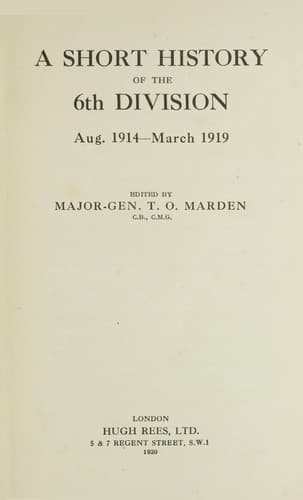
A Short History of the 6th Division: Aug. 1914-March 1919
History
A Short History of the 6th Division: Aug. 1914-March 1919
Great Britain. Army. Division, 6th; World War, 1914-1918 -- Campaigns -- Western Front; World War, 1914-1918 -- Regimental histories -- Great Britain
The diminishing pressure of the Germans on the Aisne had made it
evident that an attempt by them to reach the Channel ports would be
made very soon. This would best be frustrated by an outflanking
movement of the Allies to the north, with the ultimate aim of joining
hands with the Belgian Army at that time holding Antwerp. Sir John
French was most anxious to place the British Army in its original
position on the left of the French, as it was based on Boulogne,
Calais and Dunkirk.
The II British Corps was the first to move from the Aisne and
prolonged the French line towards La Bassee; the I and III Corps
extending inwards to relieve it. Next followed the III Corps, relieved
by the French and destined to take its place north of the II Corps
towards Bailleul.
The Cavalry Corps advanced north of the III Corps towards Kemmel, and
at a later date the I Corps, handing over to the French, was moved
towards Ypres, while the 7th Division, just arrived in France, was
directed on Menin.
The III Corps consisted of the 4th and 6th Divisions under Lt.-Gen.
Pulteney. The period 6th to 9th October was occupied in the march to
the entraining station near Compiegne. The Division detrained at St.
Omer on 10th October, and was joined by the 19th Infantry Brigade
(Brig.-Gen. Hon. F. Gordon), which remained with it until 31st May
1915. The battalions composing this brigade were 2nd R.W.F., 1st
Cameronians, 1st Middlesex, 2nd A. and S. Highlanders. The 5th
Cameronians were added on 19th November 1914.
Public-domain text, read in full here on John Shaqi.
Reviews
Reviews
No reviews yet
Be the first to share your thoughts on this work.
Join the Discussion
Join the discussion
Sign in to leave a comment or review.
Sign InorCreate an account