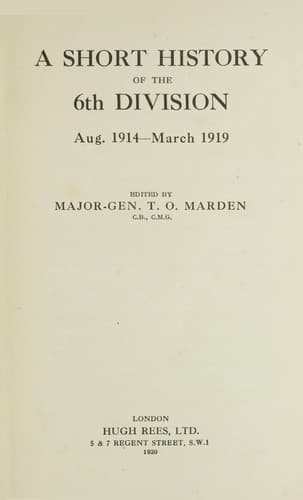
A Short History of the 6th Division: Aug. 1914-March 1919
History
A Short History of the 6th Division: Aug. 1914-March 1919
Great Britain. Army. Division, 6th; World War, 1914-1918 -- Campaigns -- Western Front; World War, 1914-1918 -- Regimental histories -- Great Britain
the gap between the right of the III Corps and the left of the I Corps
near Aubers. The advance from Hazebrouck to the ridge had occupied six
days, and cost the Division some 750 casualties.
On the morning of the 20th October the Germans attacked very heavily
on the whole front. Fighting on a very extended front (five miles) and
with very little in hand, the Division was soon in difficulties,
particularly on the exposed left flank, where the Leinsters had their
three left companies quickly driven in, and the situation at midday
was critical. One company with the machine-guns was able to hold on
until the afternoon at Mont de Premesques, and to withdraw under cover
of darkness, having inflicted heavy loss on the enemy. Meanwhile units
of other brigades were putting up a gallant fight against great odds,
each unit generally with one or both flanks unsupported. At
Ennetieres, which formed rather a salient, the Sherwood Foresters held
out all day, but were attacked at dusk by three battalions and
practically annihilated or captured, only the CO., Adjutant, Q.M. and
250 other ranks remaining the next day.
The Buffs, after a splendid fight, were driven out of Radinghem, and
by night the Division was practically back on the line which it was to
hold for the next few months, and on which the German offensive of
1918 still found the British. Continuous unsuccessful attempts to
break through occurred till 31st October, when trench warfare set in.
Notable among these was the attack on the K.S.L.I. and Y. and L. on
the 23rd October, when 300 enemy dead were left in front of our
trenches; on the 18th Infantry Brigade on the night of the 27/28th
October, when the enemy captured the line, but was driven out by a
counter-attack, in which the East Yorks specially distinguished
themselves; and on the night of the 29/30th October, when the 19th
Infantry Brigade lost some trenches, but counter-attacked
successfully, and counted 200 German dead. The incident of Cpl.
Forward, 1st The Buffs, is typical of the fierce fighting. On 30th
October, when the O.C. machine-guns of The Buffs and all the team had
been killed or wounded, this gallant N.C.O. continued to fire his gun
until eventually wounded in five places, when he crawled back to
report the situation. He was rewarded with the D.C.M. During the whole
period, 20th to 30th October, the guns were woefully short of
ammunition, and consequently a greater strain was thrown on the
infantry.
CHAPTER IV
ARMENTIERES
1914-15
Public-domain text, read in full here on John Shaqi.
Reviews
Reviews
No reviews yet
Be the first to share your thoughts on this work.
Join the Discussion
Join the discussion
Sign in to leave a comment or review.
Sign InorCreate an account