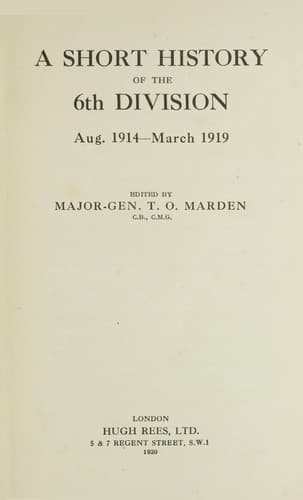
A Short History of the 6th Division: Aug. 1914-March 1919
History
A Short History of the 6th Division: Aug. 1914-March 1919
Great Britain. Army. Division, 6th; World War, 1914-1918 -- Campaigns -- Western Front; World War, 1914-1918 -- Regimental histories -- Great Britain
Active fighting now died away on this front, but its place was taken
by constant shelling and the deadly sniping which claimed so many
victims at this time. The weather during November and December was
truly appalling. All trenches were knee-deep and more in mud and
water, and it is on record that the B.G.C., 19th Infantry Brigade, had
his boots sucked off by the mud and went round trenches without them.
Parapets would not stand and were so flimsy that many men were shot
through them. But the weather eventually improved, material for
revetment began to appear, and by the commencement of 1915 it was
possible to move in the trenches in comparative safety.
The next few months were uneventful ones, the only incidents worthy of
remark being a visit from the King on the 2nd December; a minor
operation by the North Staffordshire Regiment on the 12th March,
resulting in the inclusion in our line of the unsavoury Epinette
Salient; the sudden move of the 16th Infantry Brigade to Vlamertinghe
at the time of the enemy's attack at St. Eloi in the middle of March,
and a little mining and counter-mining on the Frelinghien and Le
Touquet fronts in May. The minor operation at l'Epinette was a very
well-planned night affair, whereby the 17th Infantry Brigade advanced
their line 200-300 yards on a frontage of half a mile. It was carried
out by the 1st Battalion North Staffordshire Regiment and 12th Field
Company, and Sir H. Smith-Dorrien (Army Commander), in congratulating
the regiment, mentioned particularly Lieuts. Pope and Gordon for
fine leading. But if there was no heavy fighting, the trench casualties
from sniping and enemy shell-fire were quite considerable (see
Appendix). We had practically no artillery ammunition with which to
worry the enemy, as the following extract from the Divisional War
Diary shows:--
_24th April 1915._--"In view of the fighting in progress in the north
(Second Battle of Ypres) the Corps Commander allots an extra ten
rounds of shrapnel per gun for 18-pounders with a view to making a
demonstration by fire to hold the enemy in front of us." Amusing
reading in 1919!
The Division continued to hold a quiet but very extended front till
the end of May, receiving a succession of units from new Divisions to
serve their apprenticeship to trench warfare.
Amongst our visitors, during this period, were units of the 9th
Division, and some of those who have read Ian Hay's _The First Hundred
Thousand_ will have recognized in it a description of a part of the
trenches of the 19th Infantry Brigade.
Public-domain text, read in full here on John Shaqi.
Reviews
Reviews
No reviews yet
Be the first to share your thoughts on this work.
Join the Discussion
Join the discussion
Sign in to leave a comment or review.
Sign InorCreate an account