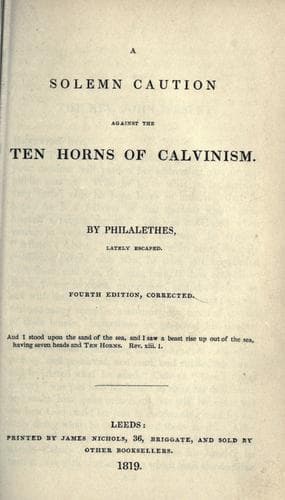
A Solemn Caution Against the Ten Horns of CalvinismTaylor, Thomas
Religion
A Solemn Caution Against the Ten Horns of Calvinism
Taylor, Thomas
Calvinism -- Controversial literature
Where shall we find the mercy of God, according to this merciless
doctrine? It is said that "mercy is his darling attribute, and that
judgment is his strange work." But according to this scheme, we must
reverse this sentence, and say that "_judgment_, or rather
everlasting destruction, is his darling attribute; and that mercy is
his strange work." It is said, that "his tender mercies are over all
his works." This must mean over such as have sinned; for such as
have not sinned, do not stand in need of mercy. But this narrow
limited doctrine does not make his mercy extend to a tenth part of
his works. If I see a multitude of poor wretches hanging over a
dreadful fiery furnace, and can extend my help to them all as easily
as to one, but will not, this speaks but little for my mercy; and as
little does this doctrine speak for the unbounded mercy of God.[3]
VII. It contradicts common sense.--There is something of a light in
the breast of every one, which the Author of our being has planted,
and which we call "the understanding." By this we are enabled to see
things in common life which are consistent or inconsistent; so even
in religious matters there may be asserted some things so shockingly
inconsistent as may affront even what we call common sense, and
perhaps may be a stumbling-block in the way of many. Should the
legislative power of England give out laws or acts of parliament to
be obeyed, and rewards promised to the obedient, and punishments
denounced to the disobedient; but at the same time, by some secret
springs of management, should so order it, that a certain number
should be constrained to obey, in some particular time, called a day
of power; and the remaining part should be under an unavoidable
necessity of disobeying, either by being constrained to
disobedience, or for want of that ability to obey which the
government could only give, but it was denied them: now must it not
shock all common sense, and all degrees of truth and justice, to
find these poor impotent wretches brought to the stake to be burnt
alive, because they could not do impossibilities? And does not every
one see the case is parallel, when the great Judge shalt pass the
sentence of condemnation at the last day, "Go, ye cursed, into
everlasting fire?"--"Why, what for? Because I have decreed it shall
be so?" No: "I was hungry, but ye gave me no meat; I was thirsty,
but ye gave me no drink." We do not find them objecting any such
decree being made against them; if there had, how could they have
been furnished with a better plea? They might have said, "Lord, thou
knowest we could not reverse thy decree, nor avoid our impending
doom. Didst thou not ordain that we should just do as we have done,
seeing thou hast fore-ordained from eternity whatsoever should come
to pass in time? So that we have just fulfilled thy counsel, and
done all thy pleasure." Here it seems pretty plain that such a
scheme must fill the prisoner's mouth with undeniable arguments,
Public-domain text, read in full here on John Shaqi.
Reviews
Reviews
No reviews yet
Be the first to share your thoughts on this work.
Join the Discussion
Join the discussion
Sign in to leave a comment or review.
Sign InorCreate an account