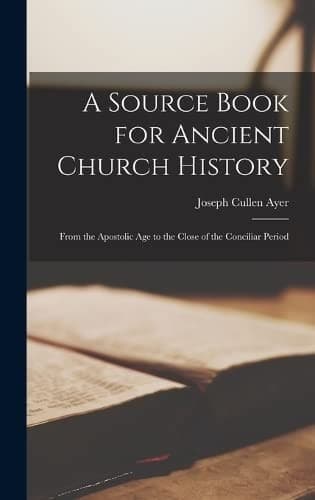
A Source Book for Ancient Church History — John Shaqi
A Source Book for Ancient Church HistoryAyer, Joseph Cullen
History
A Source Book for Ancient Church History
Ayer, Joseph Cullen
Church history -- Primitive and early church, ca. 30-600 -- Sources
Christians were convinced that their religion made the highest possible
moral demands upon them. They were to live in the world, but remain
uncontaminated by it (_cf._ _supra_, § 11). This belief even candid
heathen were sometimes forced to admit (_cf._ Pliny’s correspondence with
Trajan, _supra_, § 7). The morality of the Christians and the loftiness of
their ethical code were common features in the apologies which began to
appear in the post-apostolic period (_cf. The Apology of Aristides,
infra_, § 20, _a_). Christianity was a revealed code of morals, by the
observance of which men might escape the fires of hell and obtain the
bliss of immortality (_a_) (_cf. infra_, § 30). At the same time there was
developed a tendency toward asceticism, by which a higher excellence might
be obtained than the law required of ordinary Christians (_b__, __c_).
This higher morality was not without its compensations; superior merit was
recognized by God, and was accordingly rewarded; it might even be applied
to offset sins committed (_d__, __e_). This last idea is to be traced to
the book of Tobit (cf. also James 5:20; I Peter 4:8). The fuller
development is to be found in the theology of Tertullian and Cyprian (v.
_infra_, § 39).
(_a_) Justin Martyr, _Apologia_, I, 10, 12. (MSG, 6:339, 342.)
Ch. 10. We have received by tradition that God does not need man’s
material offerings, since we see that He himself provides all things. And
we have been taught, have been convinced, and do believe that He accepts
only those who imitate the virtues which reside in Him, temperance and
justice and philanthropy, and as many virtues as are peculiar to a God who
is called by no given name. And we have been taught that He in the
beginning, since He is good, did for man’s sake create all things out of
unformed matter; and if men by their works show themselves worthy of His
design, they are deemed worthy, for so we have received, of reigning in
company with Him, having become incorruptible and incapable of suffering.
For as in the beginning He created us when we were not, so we consider
that, in like manner, those who choose what is pleasing to Him are, on
account of their choice, deemed worthy of incorruption and of fellowship
with Him. For the coming into being at first was not in our power; and in
order that we may follow those things which please Him, choosing them by
means of the rational faculties with which He has himself endowed us, He
both persuades us and leads us to faith.…
Public-domain text, read in full here on John Shaqi.
Reviews
Reviews
No reviews yet
Be the first to share your thoughts on this work.
Join the Discussion
Join the discussion
Sign in to leave a comment or review.
Sign InorCreate an account