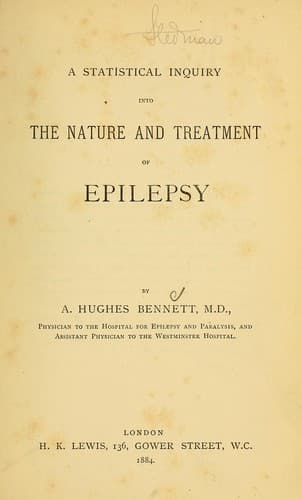
A Statistical Inquiry Into the Nature and Treatment of EpilepsyBennett, Alexander Hughes
Science
A Statistical Inquiry Into the Nature and Treatment of Epilepsy
Bennett, Alexander Hughes
Epilepsy
In all, the usual characteristics of the _petit mal_ presented
themselves; there being temporary loss of consciousness, sometimes with
slight spasms, but without true convulsion, biting of the tongue, &c.
_Frequency of Attacks._--The rough average frequency of attacks, as
estimated in the cases under consideration, was as follows:--
20 to 30 attacks per day in 3.7 per cent.
10 to 20 attacks per day in 7.4 per cent.
5 to 10 attacks per day in 14.8 per cent.
1 to 5 attacks per day in 40.7 per cent.
1 or more attacks per week in 22.2 per cent.
1 or more attacks per month in 7.4 per cent.
At rarer intervals in 3.7 per cent.
Thus when epilepsia mitior exists, in the majority of cases the attacks
are of daily occurrence.
_Loss of consciousness_, as ascertained in a series of cases, was
Complete in 48.3 per cent.
Partial in 51.6 per cent.
_Premonitory Symptoms._--These are not, as a rule, so well marked in
epilepsia mitior as in E. Gravior; but frequently the aura is quite as
distinctly appreciated. In the 28 per cent. of cases in which E. Mitior
is associated with E. Gravior, the aura was apparently the same in both.
Of the 10 per cent. cases of E. Mitior occurring by itself, the
following is the record:--
No aura in 20 per cent.
Sensation in epigastrium in 20 per cent.
Loss of speech in 10 per cent.
Violent pain in head in 10 per cent.
Tingling of extremities in 10 per cent.
Choking sensation in 10 per cent.
Hallucination in 10 per cent.
Vertigo in 10 per cent.
The number of cases in E. Mitior is too limited to warrant further
generalization.
FOOTNOTES:
[A] Reprinted from the "British Medical Journal" of March 15 & 22, 1879.
II.
AN INQUIRY
INTO THE
ACTION OF THE BROMIDES ON
EPILEPTIC ATTACKS.[B]
Bromide of potassium is generally recognised as the most effective
anti-epileptic remedy we at present possess. There exists, however,
great difference of opinion as to its method of administration and to
the amount of benefit which we may expect from its use. Some physicians
who employ the drug after one method come to totally different
conclusions as to its efficacy from those who use another. Many believe
the remedy to be only useful in certain forms of the disease, and to be
very uncertain and imperfect in its action. Others, again, maintain that
it is positively injurious to the general health of the patient. These
and other unsettled points the following inquiry attempts to make clear.
Public-domain text, read in full here on John Shaqi.
Reviews
Reviews
No reviews yet
Be the first to share your thoughts on this work.
Join the Discussion
Join the discussion
Sign in to leave a comment or review.
Sign InorCreate an account