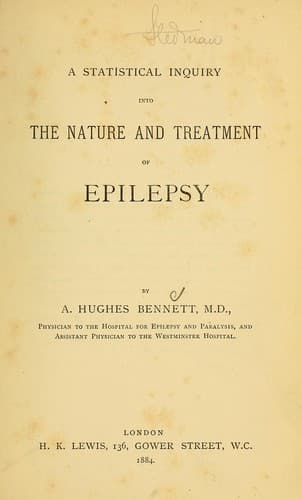
A Statistical Inquiry Into the Nature and Treatment of EpilepsyBennett, Alexander Hughes
Science
A Statistical Inquiry Into the Nature and Treatment of Epilepsy
Bennett, Alexander Hughes
Epilepsy
Epilepsy, like all other chronic diseases, presents great difficulties
in scientifically estimating the exact value of any particular remedy;
and unless the investigation of the subject is approached with the
strictest impartiality, and observations made with rigid accuracy, we
are liable to fall into the most misleading fallacies. I believe that
these are to be avoided, and facts arrived at, however laborious it may
be to the experimenter and wearisome to the student, only by the careful
observation and elaborate record of an extensive series of cases. If, in
epilepsy, the disease, from its prolonged duration, its doubtful
causation and pathology, its serious complications and the many other
mysterious circumstances connected with it, offers almost unsurmountable
difficulties to any definite and uniform method of treatment and the
systematic estimation of the same, its symptoms furnish us with
tolerably accurate data upon which to base our observations. The
attacks, although only symptoms, may be practically considered as
representing the disease, as in the large majority of cases, in
proportion as these are frequent and severe, so much the more serious is
the affection. The influence of the bromides on these paroxysms is taken
in the following inquiry to represent the action of these drugs on the
epileptic state.
Before proceeding to detail the facts arrived at, it is necessary
briefly to state the method of procedure adopted in treatment. Each case
in succession, and without selection, which was pronounced to be
epilepsy (all doubtful cases being eliminated), was considered as a
subject suitable for experiment. The general circumstances of the
individual were studied; his diet, hygienic surroundings, habits, and so
on, if faulty, were, when practicable, improved. The bromides were then
ordered, and taken without intermission for periods which will
subsequently be detailed. The minimum quantity for an adult, to begin
with, was thirty grains three times a day, the first dose half an hour
before rising in the morning, the second in the middle of the day on an
empty stomach, and the third at bedtime. This was continued for a
fortnight, and if with success, was persevered with, according to
circumstances, for a period varying from two to six months. If, on the
other hand, the attacks were not materially diminished in frequency, the
dose was immediately increased by ten grains at a time till the
paroxysms were arrested. In this way as much as from sixty to eighty
grains have been administered three times daily, and, with one or two
isolated exceptions to be afterwards pointed out, I have met with no
case of epilepsy which altogether resisted the influence of these large
doses; and, moreover, I have never seen any really serious symptoms of
poisoning or injury to the general health ensue in consequence.
Sometimes these quantities of the drugs have been taken for many months
with advantage; but as a rule it is preferable, when possible, after a
Public-domain text, read in full here on John Shaqi.
Reviews
Reviews
No reviews yet
Be the first to share your thoughts on this work.
Join the Discussion
Join the discussion
Sign in to leave a comment or review.
Sign InorCreate an account