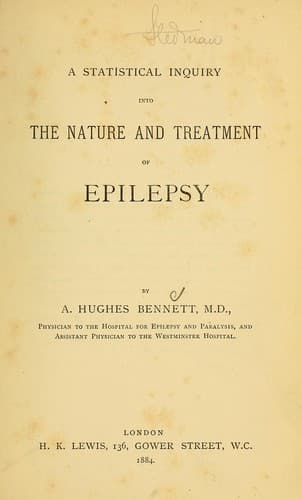
A Statistical Inquiry Into the Nature and Treatment of EpilepsyBennett, Alexander Hughes
Science
A Statistical Inquiry Into the Nature and Treatment of Epilepsy
Bennett, Alexander Hughes
Epilepsy
1 300 3 --
2 60 1 --
3 60 4 --
4 30 1 --
5 16 -- 10
6 12 -- 3
7 8 0 0
8 1 0 0
These four tables consist of all the characteristic cases of epilepsy
which came under notice, without selection of any kind, all being
included, no matter what their form or severity, their age, complication
with organic disease, etc. In analyzing this miscellaneous series, the
chief fact to be noticed, whether the period of treatment has been
limited to six months or extended to four years, is the remarkable
effect of treatment upon the number of the epileptic seizures. Of the
total 117 cases, in 14, or about 12.1 per cent., the attacks were
entirely arrested during the whole period of treatment. In 97, or about
83.3 per cent., the monthly number of seizures was diminished. In 3, or
about 2.3 per cent., there was no change either for better or worse; and
in 3, or about 2.3 per cent., the attacks were more frequent after
treatment.
With regard to the fourteen cases which were free from attacks during
treatment, it cannot, of course, be maintained that all of these were
cured in the strict sense of the term. It is probable that if any of
them discontinued the medicine the seizures would return. Still, the
results are such as to encourage a hope that if the bromides are
persevered with, and the attacks arrested for a sufficiently long
period, a permanent result might be anticipated. Even should no such
ultimate object be realized, it is obvious that an agent which can,
during its administration, completely cut short the distressing
epileptic paroxysms, without injuriously affecting the mental or bodily
health, is of immense importance. Take, for example, cases 7 and 8 of
Table IV., where, prior to treatment, in the one case eight fits a
month, and in the other one, were completely arrested during a period of
nearly four years. The experience of physicians agrees in considering
that the danger of epilepsy, both to mind and body, is in great part
directly proportionate to the severity of its symptoms. If these latter
can be completely arrested, even should we be compelled to continue the
treatment, if this is without injury to the patient, it is as close an
approach to cure as we can ever expect to arrive at by therapeutic
means. The permanent nature of the improvement, and the possibility of
subsequent discontinuance of the bromides without return of the disease,
is a question I shall not enter into, as my own personal experience is
not yet sufficiently extended to be able to form a practical opinion. A
satisfactory solution of this problem could only be made after a
life-long private practice, or by the accumulated experience of many
observers. With hospital patients such is almost impossible, as they are
Public-domain text, read in full here on John Shaqi.
Reviews
Reviews
No reviews yet
Be the first to share your thoughts on this work.
Join the Discussion
Join the discussion
Sign in to leave a comment or review.
Sign InorCreate an account