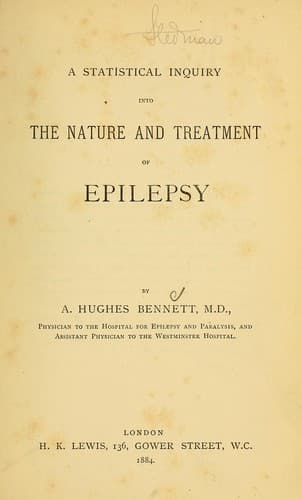
A Statistical Inquiry Into the Nature and Treatment of EpilepsyBennett, Alexander Hughes
Science
A Statistical Inquiry Into the Nature and Treatment of Epilepsy
Bennett, Alexander Hughes
Epilepsy
lost sight of, especially if they recover.
Of the total 117 cases which compose the tables, we find that in no less
than 97 were the attacks beneficially influenced by the bromides. In the
different cases this improvement varies in degree, but in most of them
it is very considerable--for example, Nos. 2, 5, 8, 11, 20, in Table I;
Nos. 5, 6, 11, 15, in Table II; Nos. 3, 4, 5, 6, in Table III; and all
the cases in Table IV. In these and others the attacks, if not actually
arrested, were so enormously curtailed, both in number and severity, in
comparison to what existed before treatment, as to constitute a most
important change in the condition of the patient. In those cases in
which improvement was not so well marked, in many it was most decided,
and in frequent instances caused life, which had become a burden to the
patient and his friends, to be bearable.
Of the total number of cases, in 3 the administration of the bromides
had no effect whatever in diminishing the attacks, and in 3 others the
number of seizures was greater after treatment than before. Whether in
these last this circumstance was the result of the drug, or due to some
co-incident augmentation of the disease itself, I cannot decide, but am
inclined to believe in the latter as the explanation.
After a consideration of these facts it is difficult to understand why
most physicians look upon epilepsy as an _opprobrium medicinæ_, and of
all diseases as one of the least amenable to treatment, and the despair
of the therapeutist. For example, Nothnagel, one of the most recent and
representative authorities on the subject, in speaking of the treatment
of epilepsy, says, "Many remedies and methods of treatment have isolated
successes to show, but nothing is to be depended on; nothing can, on a
careful discrimination of cases, afford a sure prospect of recovery, or
even improvement." Such a statement indicates either an imperfect method
of treatment, or that in Germany epilepsy is more intractable than in
this country, as a "careful discrimination" of the above cases affords a
"sure prospect of improvement" and a reasonable one of recovery. That a
critical spirit and healthy scepticism should exist regarding the vague
and imperfect accounts of the efficacy of various drugs in disease is, I
believe, necessary to arrive at the truth; at the same time, we must not
refuse to credit evidence sufficiently based on observation and
experiment. The above collection of cases are facts, carefully and
laboriously recorded, and not originally intended for the purpose which
they at present fulfil. Having been brought up in the belief that
epilepsy was one of the most intractable of diseases, no one is more
surprised than myself at the readiness with which it responds to
treatment. So far, then, from this affection being the despair of the
profession, I believe that of all chronic nervous diseases it is the one
most amenable to treatment by drugs, resulting, if not in complete cure,
Public-domain text, read in full here on John Shaqi.
Reviews
Reviews
No reviews yet
Be the first to share your thoughts on this work.
Join the Discussion
Join the discussion
Sign in to leave a comment or review.
Sign InorCreate an account