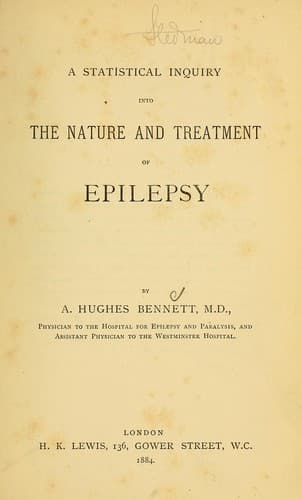
A Statistical Inquiry Into the Nature and Treatment of EpilepsyBennett, Alexander Hughes
Science
A Statistical Inquiry Into the Nature and Treatment of Epilepsy
Bennett, Alexander Hughes
Epilepsy
in great amelioration of the symptoms which practically constitute the
disease.
An important consideration next arises. Assuming that practically the
treatment in all cases is alike, are there any special circumstances
which explain why some patients should have no attacks while under the
influence of the drugs, while others are only relieved; why some--though
the number is very small--should receive no benefit, and others have a
larger number of attacks after treatment? On a careful examination of
all the clinical facts of each case, no explanation can be found, the
same form of attack, the same complications and circumstances, occupying
each group. For example, one of those who had no attacks during
treatment was a woman who had been afflicted with epilepsy for eighteen
years, of a severe form, with general convulsions, biting tongue, etc.
Another was a very delicate, nervous woman, who suffered, in addition to
the seizures, from pulmonary and laryngeal phthisis, who came of a
family impregnated with epilepsy, and whose intellect was greatly
impaired. By far the largest class are those benefited by treatment, and
these comprehend every species of case, chronic and recent, complicated,
inherited, in the old and young, and so on; yet the most careful
analysis fails to discover why some should be more amenable to treatment
than others, or give any indication which might be useful in prognosis.
Neither does a study of the few cases which the bromides did not affect,
or those which increased in severity under their influence, throw any
light upon the subject, as some of these latter gave no indications
beforehand of their unfortunate termination, and in none of them was
there any serious complication or special departure from good mental or
bodily health.
Another point must be noted, although there is no statistical method of
demonstrating the fact, namely, that in those cases in which the attacks
were not completely arrested, but only diminished in number, those
seizures which remained were frequently greatly modified in character
while the patient was under the influence of the bromides. These were
less severe, and characterized by the patients as "slight," while
formerly they were "strong." This by itself often proves of great
service, as, instead of a severe convulsive fit, in which the patient
severely injures himself, bites his tongue, etc., he has what he calls a
"sensation," in other words, an abortive attack.
Public-domain text, read in full here on John Shaqi.
Reviews
Reviews
No reviews yet
Be the first to share your thoughts on this work.
Join the Discussion
Join the discussion
Sign in to leave a comment or review.
Sign InorCreate an account