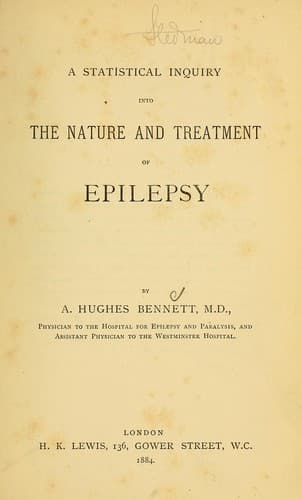
A Statistical Inquiry Into the Nature and Treatment of Epilepsy — John Shaqi
A Statistical Inquiry Into the Nature and Treatment of EpilepsyBennett, Alexander Hughes
Science
A Statistical Inquiry Into the Nature and Treatment of Epilepsy
Bennett, Alexander Hughes
Epilepsy
2. Although some persons, suffering from epileptic seizures, are, in the
intervals, of sound mind and body, in many the inter-paroxysmal state is
characterized by certain symptoms peculiar to this condition, and
independent of any form of treatment. These vary from the slightest
departures from health to the most serious mental and physical disease.
The general health is frequently unsatisfactory; the functions of the
body being impaired in vigour, the digestion is weak, and the
circulation feeble. The entire nervous system is in an unstable
condition, the patient being at one time irritable and excitable, and at
another depressed and despondent. There is a very common condition of
so-called "nervousness" which is accompanied by headache, pains,
tremors, and a variety of other subjective phenomena. The mental powers
are enfeebled, the memory defective, and these intellectual alterations
may exist in any degree, even to permanent and intractable forms of
insanity. The physical conditions may also be changed, the nutrition of
the tissues is often imperfect, the skin is pale, the muscles flabby,
and the motor powers generally enfeebled, all of which may also present
different degrees of severity, so as to culminate in actual paralysis.
Admitting, then, that the prolonged and excessive administration of the
bromides causes a series of abnormal symptoms in the healthy individual,
affecting mainly the general nutrition, the mental faculties, and the
sensory and motor functions, and also that the epileptic state is itself
frequently accompanied by impairment of innervation of a somewhat
analogous nature, it follows that when the drug is given for the relief
of the disease, care must be taken not to confound the two series of
phenomena with one another. With this precaution in view, granting that
the therapeutic agent beneficially controls and suppresses the
convulsive seizures, we proceed to discuss whether in so doing it in any
way injuriously influences the constitution of the patient. To answer
this question has been found by no means easy. Comparatively few
physicians have opportunities of observing cases of epilepsy in
sufficient numbers to form substantial conclusions on the subject. Even
in favoured circumstances it is difficult, especially in hospital
practice, to ensure the regular attendance of the patient or to keep him
sufficiently long under observation. The study and the recording of the
facts, moreover, demand an expenditure of much time and labour. These,
added to the sources of fallacy already enumerated, render the inquiry
a complicated one; but it is believed that an approximation to the truth
may be arrived at by the following method of investigation.
Public-domain text, read in full here on John Shaqi.
Reviews
Reviews
No reviews yet
Be the first to share your thoughts on this work.
Join the Discussion
Join the discussion
Sign in to leave a comment or review.
Sign InorCreate an account