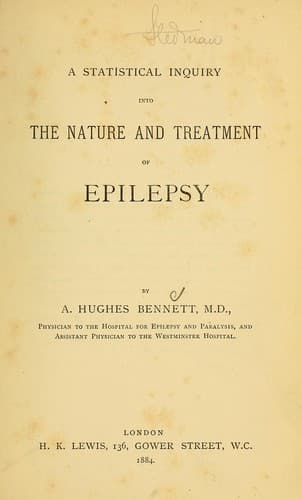
A Statistical Inquiry Into the Nature and Treatment of EpilepsyBennett, Alexander Hughes
Science
A Statistical Inquiry Into the Nature and Treatment of Epilepsy
Bennett, Alexander Hughes
Epilepsy
While attempting to estimate the therapeutic value of the bromides from
a statistical aspect, one likely source of fallacy must not be
overlooked. Most patients, and especially those attending hospitals, are
difficult to keep under observation for long periods, more particularly
if the progress of the case is unsatisfactory. In this way we may lose
sight of those who do not benefit by treatment or who are injured by it.
Although it is difficult to estimate these with accuracy, a certain
rebatement must always be made on this count in computing results. At
the same time we have in the present inquiry positive evidence, in a
considerable number of cases, of the innocuous and beneficial nature of
the drug, against the negative possibility only of its disadvantages. Of
the 141 cases under notice, I only know of three who have died, and all
of then of phthisis pulmonalis. The relations existing between the
mortality and cause of death on the one hand, and the disease and
treatment on the other, the paucity of the data do not permit us to
determine.
A further study of the tables would also seem to show that while the
beneficial action of the bromides remains permanent, the deleterious
effects diminish the longer the drug has been taken. This is doubtless
due, as in the case of most poisons, to the system becoming habituated
to its use. It has often been observed that the most marked effects of
bromism have appeared at the beginning of treatment, and that the
eruption, the physical and mental depression, &c., subsequently
disappeared, although the medicine was persevered in. Those who have
been under its influence for some years rarely present any symptoms
directly attributable to the toxic effects of the bromides; and if
abnormal conditions do exist, these are the sequelæ of the malady, and
not the results of treatment, as shown by the fact that when the last is
suspended, the original sufferings are augmented.
It may be suggested that a prolonged use of the bromides becomes, as in
the case of opium, a habit. There is, however, a marked distinction
between the two. Opium-smoking is a vice not only deleterious in itself,
but one indulged in merely to satisfy a morbid craving. The bromides, on
the other hand, are less hurtful in their effects, and are taken to
avert the symptoms of a distressing and terrible malady. Assuming, then,
that their consumption becomes a necessity, if it can be shown that the
results are not serious, while the evils they avert are important, the
habit acquired may be looked upon as a justifiable one.
Public-domain text, read in full here on John Shaqi.
Reviews
Reviews
No reviews yet
Be the first to share your thoughts on this work.
Join the Discussion
Join the discussion
Sign in to leave a comment or review.
Sign InorCreate an account