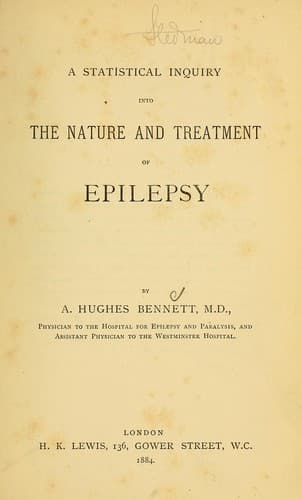
A Statistical Inquiry Into the Nature and Treatment of EpilepsyBennett, Alexander Hughes
Science
A Statistical Inquiry Into the Nature and Treatment of Epilepsy
Bennett, Alexander Hughes
Epilepsy
A general review of all these circumstances seems to render it probable
that the epileptic constitution is more tolerant of the toxic effects of
the bromides than the healthy system. The most severe effects of bromism
occur in those who are not the victims of this malady, in whom, as seen
by the foregoing facts, they are not common. Theoretically this may be
plausibly explained by the reasonable assumption that, as in epilepsy
the entire nervous apparatus is in a state of reflex hyper-excitability,
the sedative and poisonous effects of the bromides do not produce the
depressing or toxic actions they would do in a more stable organization.
Whatever the reason may be, the fact is that the symptoms of bromism are
not so severe in the epileptic as they are in otherwise healthy
subjects.
Finally, the important question arises, Does a prolonged use of the
bromides tend towards the eradication of the disease itself and the
ultimate cure of the epileptic state? On this point I have no personal
statistical evidence to offer, nor am I aware of the existence of any
sufficiently scientific series of data to settle the question. Without
there being actual demonstration of the fact, there is every reason to
believe that such a supposition is possible. Clinical observation has
determined that the larger the number of convulsive seizures the greater
is the tendency to the production of others, and the more readily are
they caused. Such is the abnormal reflex hyper-excitability of the
nervous system of the epileptic that the irritative effects of one
attack seem directly to pre-dispose to the occurrence of a second; so
that the larger the number of explosions of nerve instability which
actually take place, the more there are likely to follow. Could such
seizures be kept in check, this cause of the production of convulsions
at least would be diminished, the liability for them to break out as a
result of trifling external stimuli would be lessened, and the
long-continued absence of this source of irritation might by the repose
and favourable circumstances thus obtained, encourage a healthy
transformation of tissue. Now, it has already been pointed out that in
12.1 per cent. of epileptics the attacks were completely arrested during
the entire time the drugs were being administered, and that in a much
larger percentage they were greatly modified in number and severity. It
has been further shown that the remedies themselves, even when in use
for long periods, are in themselves practically innocuous, while at the
same time they continue to maintain their beneficial effects on the
attacks. It therefore follows that a sufficiently prolonged treatment
might in a certain number of cases be succeeded by permanent curative
results. The chief impediment to arriving at trustworthy conclusions on
this subject has been the length of time necessary to judge of lasting
benefits, and the difficulty of keeping patients sufficiently long under
observation.
Public-domain text, read in full here on John Shaqi.
Reviews
Reviews
No reviews yet
Be the first to share your thoughts on this work.
Join the Discussion
Join the discussion
Sign in to leave a comment or review.
Sign InorCreate an account