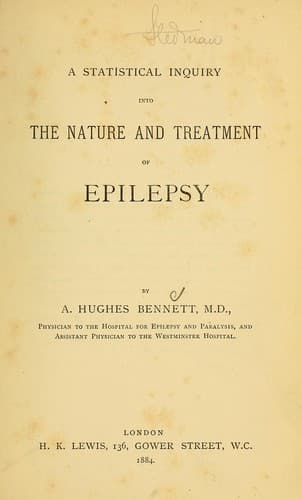
A Statistical Inquiry Into the Nature and Treatment of EpilepsyBennett, Alexander Hughes
Science
A Statistical Inquiry Into the Nature and Treatment of Epilepsy
Bennett, Alexander Hughes
Epilepsy
Loss of sight in 2.3 per cent.
Loss of speech in 13.9 per cent.
Loss of hearing in 2.3 per cent.
General tremor in 16.2 per cent.
Tremor of one foot in 2.3 per cent.
Sensation in epigastrium in 6.9 per cent.
Sensation in abdomen in 4.6 per cent.
Sensation in throat in 6.9 per cent.
Sensation in left side in 2.3 per cent.
Sensation in both hands in 2.3 per cent.
Sensation in one hand in 2.3 per cent.
Violent pain in head in 2.3 per cent.
Pain in one foot in 2.3 per cent.
Sparkling sensation in eyes in 6.9 per cent.
Pumping sensation in head in 4.6 per cent.
Noises in ears in 4.6 per cent.
Diplopia in 2.3 per cent.
Contraction of one leg in 2.3 per cent.
Rotation of head in 2.3 per cent.
Distortion of face in 2.3 per cent.
Twitching of thumb in 2.3 per cent.
Spasm of eye-balls in 2.3 per cent.
Disagreeable smell in 2.3 per cent.
From these figures we find that in 34.4 per cent. of the cases of
epilepsia gravior there are no special symptoms announcing the seizure,
which takes place without warning of any kind; and it is especially in
such cases that patients in falling, seriously injure themselves. In
65.5 per cent. there are premonitory symptoms of some kind, which
indicate often many hours before the approach of an attack. Of these
last 47.4 per cent. are of a general character, and in no less than 72.8
per cent. is there a distinct special aura, which in 25.4 per cent.
alone precede the attack, the remainder being associated with the
general premonitory symptoms.
_Symptoms of the Attack._--In the cases of epilepsia gravior there were
complete loss of consciousness with convulsions, lasting from five to
ten minutes, and occurring at intervals, leaving no question as to the
true nature of the disease, and all doubtful examples have been excluded
from this collection. Attempts were made to form an analysis of the
different symptoms constituting the paroxysm, but with indifferent
success, and these are not here reproduced, because they are not
sufficiently accurate for scientific purposes. The patient himself can
give no account of what takes place. The friends around do not look upon
the phenomena of the attack with the critical and philosophic eye of the
physician; hence any information from them as to the part convulsed, the
colour of the skin, the duration of the seizure, and so on, is extremely
vague and untrustworthy. The number of cases personally observed
actually during attacks is too limited to warrant any generalizations.
There is, however, one important point which can be accurately
demonstrated--namely, whether or not the tongue is bitten, and in the
cases under observation
The tongue was bitten in 68.8 per cent.
The tongue was not bitten in 31.2 per cent.
Public-domain text, read in full here on John Shaqi.
Reviews
Reviews
No reviews yet
Be the first to share your thoughts on this work.
Join the Discussion
Join the discussion
Sign in to leave a comment or review.
Sign InorCreate an account